Calling Party Number
The calling party number (A-party) can be conveyed to the called party if the intermediate signaling system supports this. The calling party number consists of the complete calling number (A-party) and TON.
In the originating exchange the complete number is composed of the A party directory number and exchange numbers which are stated in the parameters EXNOPR and EXNOPU, see Public Numbers and Private Numbers.
What EXNOPU, EXNOPR -values to choose depends of the value (0-4 and 5-7 respectively) stated in the respective TON (for the ADC parameter in the RODDI command). The values in the parameters EXNOPR, EXNOPU, and ADC must be initiated with regard to the connected exchanges.
It is possible to send different calling party numbers, depending on destination and selected route.
The calling party number (directory number or ROUDIR) can if necessary be converted by the command number_conversion_initiate, using the parameter -conversionnumbertype = ’sent A number and sent connected number’, and a corresponding value in the -numbertype parameter.
Note: The presentation indicator is used to restrict the presentation of calling party number to the called party. If the calling party has restricted presentation, a common public directory number can be used, see below.
Common public directory number as calling party number
According to called, calling and connected party number, the same rules mentioned in the section above are applicable for initiating common public directory numbers. Additions are:
In the KSEXI or EXTEI commands, network affiliation shall be stated in parameter ADC if the calling party number is not possible or not allowed to be sent to the PSTN. In extension_profile -i the network affiliation in --ext-npres shall also be set appropriately.
If the calling party number of the A-party is not possible or not allowed to be sent, a calling party number using the common public directory number (stated in command route_data_common) with relevant exchange numbers and TON can be sent.
Common public directory number can only be initiated per system, per LIM and per customer.
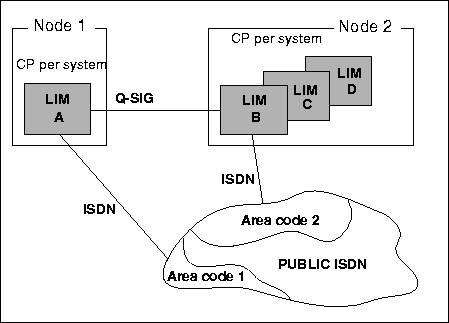
For extensions in LIM A, the common public directory number initiated for Node1 will be used for calls to public ISDN. For extensions in LIM B, C, and D, the common public directory number initiated for Node2 will be used for calls to public ISDN. The use of the above stated common public directory number is independent of how the call is routed.
ROUDIR as calling party number
If the calling party number is sent from exchange A, this number will be transferred transparently through exchange B to the public ISDN.
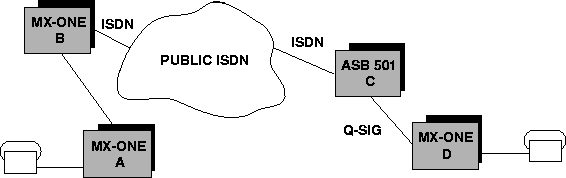
If the tie line A-B does not support calling party identity transfer, or if no calling party number is sent from exchange A, the B exchange will compose a calling party number to be sent to the ISDN by means of:
- Exchange numbers for outgoing public route (EXNOPU) + ROUDIR for the incoming tie line route. The parameters are initiated per route.
- Or if no ROUDIR is defined for the incoming tie line route, no number will be sent to the ISDN.
The following commands are used to control calling number:
| Command | Parameters |
|---|---|
route_data_common -i |
--public-directory-number, --public-number |
RODDI |
ADC |
RONDI |
EXNOPU, EXNOPR, ROUDIR |