Advice of Charge
General:
Advice of Charge (AOC) is a service that provides display of charging information (in currency) received from the public ISDN network, to a charged extension with an appropriate display, in the PBX. The information is conveyed through the private homogeneous ISDN/H.323 network based on the ISO standard for AOC. H.323/ISDN transit is also considered an homogeneous network.
When the standard protocols for AOC are used, the type of charging desired is set per route in the VARO parameter in the command RODAI. The different types of AOC services that can be set are charge during the call (AOC-D) or charge at the end of the call (AOC-E) or both. The initiation of AOC related data (command groups RO, AS and KS) is described below.

-
Extensions must be initiated (KS, extension, ip_extension)
-
Initiate public ISDN and private ISDN/H.323 charging routes (RO), with AOC and GFP support
-
Initiate cost per charging unit (pulse) for pulse-currency conversion
-
Initiate correct text strings, and currency format (KS/AS)
Execution:
Extensions are assumed to be initiated. Both private and public ISDN/H.323 routes should be initiated as charging routes. Private ISDN/H.323 routes should have network services supported. Key the commands:
ROCAI:...,SIG=; or
ROCAC:...,SIG=;
The support for the standardized Generic Functional protocol must be initiated on each route that uses the standard protocols for AOC. This applies both for private and public routes. The support of the Generic Functional protocol is set per route in the VARI parameter for the command RODAI. H.323 routes support GFP as a standard.
The MX-ONE only supports AOC according to the ISO standard in private networks.
For public routes, several different charging protocols are supported in addition to the standard version (ETSI). If the public network does not support AOC according to the ETSI standard, the type of protocol used is controlled by market dependent parameters.
When the standard protocols for AOC are used, the type of charging desired is set per route in the VARO parameter in the command RODAI. The different types of AOC services that can be set are charge during the call (AOC-D) or charge at the end of the call (AOC-E) or both. The services can be set independently. The charging information from the public ISDN is available for all calls, or requested on a per call basis. If it is requested on a per call basis and the public network supports AOC according to the ETSI standard for AOC, then the type of charging request used must be set. This is also set per route in the VARO parameter for the command RODAI.
Initiation of cost per charging unit (pulse)
Charging information may be received either as a cost in a currency amount or as units (pulses). The cost is always displayed as a currency amount at the user. If the cost information is received as units it is always necessary to calculate the corresponding currency amount. On the other hand, the charging counters only use charging information stored as units (pulses). This means that if the cost information is received as a currency amount, it is always necessary to calculate the corresponding cost in units.
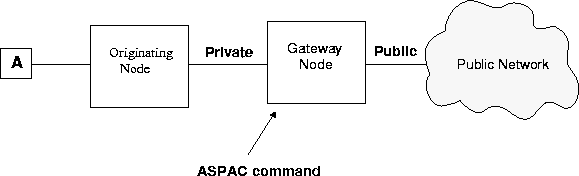
The cost per unit (pulse) is controlled per exchange with an application system parameter. Key the command:
ASPAC:PARNUM=150,PARVAL=...;
Finally, set an application system parameter controlling the currency format, using the command:
ASPAC:PARNUM=150,PARVAL=...;
in order, for example, to select whether to use decimal point (cost per pulse in hundredths, depending on the currency) or not. If the charging information was received as units and the cost per unit was entered in fractions, the cost amount will also be displayed with fractions (hundredths).
Initiation of default AOC text strings (currency)
The currency identifier is normally transferred from the public network to the private network. If no currency identifier has been received from the public network, a default currency identifier string must be used. There are two different strings that can be set. The first string is used in a public gateway exchange before sending any cost information to the private network. It is set with an application system parameter:
ASPAC:PARNUM=185,PARVAL=...;
The parameter uses the corresponding currency code for the desired currency identifier according to the standard ISO 4217. A currency identifier is always received from the private network in the originating exchange. However it is not mandatory from a public network.
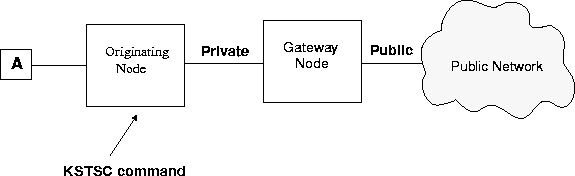
If no currency identifier has been received from a public network connection, another default currency identifier string is added in the originating exchange. The string is set with the command:
extension_text -c --ext-display-option MIS14 --ext-display-string