Initiation of ENT Data
General
The External Number Table (ENT) can hold up to 50000 entries, each containing one to sixteen digits, including the LAC.
For example, see the following figure.
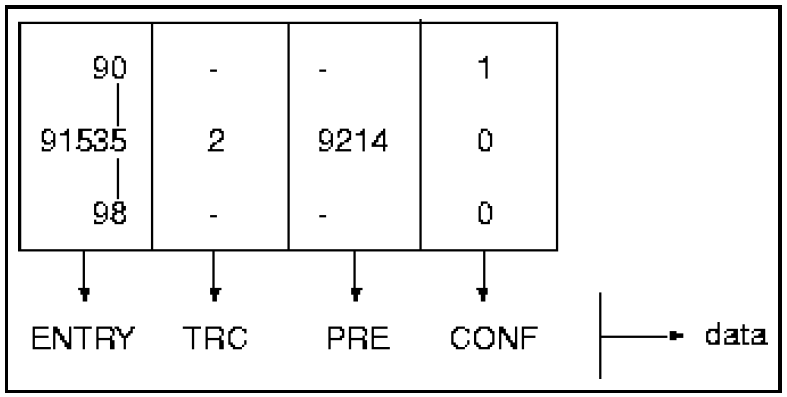
ENT Table
Using a complex Numbering Plan, ENT distinguishes conflicting numbers and avoids conflict situations for markets.
When one type of call is represented by a number that is the same as the beginning of a number representing some other type(s) of call, and when it is not defined to use the LCR facility, critical timing must be used to decide that the last digit of the number is received.
There are three possible cases:
- If a time-out occurs, the number will be rearranged according to the data in ENT. If the rearranged number is to a public destination, the LCR analysis will continue. If the rearranged number is an internal or external private number, complete or incomplete (that is, more digits to be expected) number, the number analysis will continue according to the type of number dialed.
- If more digits are dialed before time-out, the LCR analysis will continue.
- If the number is not marked as a conflicting number, it is to be rearranged according to the data in ENT, and then analysis continues as in case 1 above.
Also, if the Numbering Plan defines a complex structure or a multiple definition of access codes to different districts in a country where the LCR facility is applied, it is required to transform them into one unique code.
According to this (for US application), the previous table can be explained as follows: Digit 9 represents LAC. Digits 9214 represent LAC + adjacent NPA AC (see below)
Note: If this number is a conflict number in NLT, the number length will be calculated using the rearranged number's length (9214535).
Digit 0 after LAC can be called for Operator, Operator assistance, International call, or International call with operator assistance and can be followed with none, one, or several digits. According to that, no digits are truncated or prefixed, but the number is marked CONFLICT, and if additional digits are dialed, the analysis continues in the NLT table.
Digit 1 after LAC is for calls to adjacent Area Codes in the Numbering Plan (NPA AC). If the two digits match, the first two must be truncated, and the number must be prefixed with LAC + AC. After that, the analysis continues in the NLT table.
Digit 8 after LAC is the first digit of an Area Code or Office Code (AC/OC). No digits are to be truncated or prefixed. Continue the analysis in the NLT table.
Prerequisites
Refer to Prerequisites.
Execution
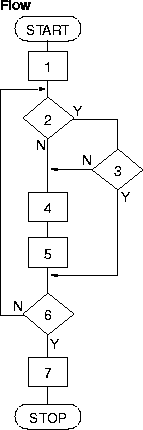
Initiate ENT Table Data
| Measure/Question | Observation/Comment | ||
|---|---|---|---|
|
|
1 |
Key the command LCDDP to verify existence of data. |
|
|
2 |
Do the data to be initiated already exist? |
||
|
3 |
Are data correct? |
||
|
4 |
Key the command LCDDI to initiate data . |
||
|
5 |
Verify the result with command LCDDP. |
||
|
6 |
Are all data that should be initiated inserted? |
||
|
7 |
Proceed with initiation of corresponding data in other tables. |
Refer to other sections |