How the Integration Works
When a user dials the emergency number 911, the call engine inside MX-ONE will look for the type of device used to make the call and collects the appropriate data (A-Number, Geolocation, BSSID, MAC address, and an ELIN/CESID or an IP address), if available.
After that, the MX-ONE system prepares the data (A-Number or Location ID) to be sent via the SIP trunk to the RedSky NG911 service provider.
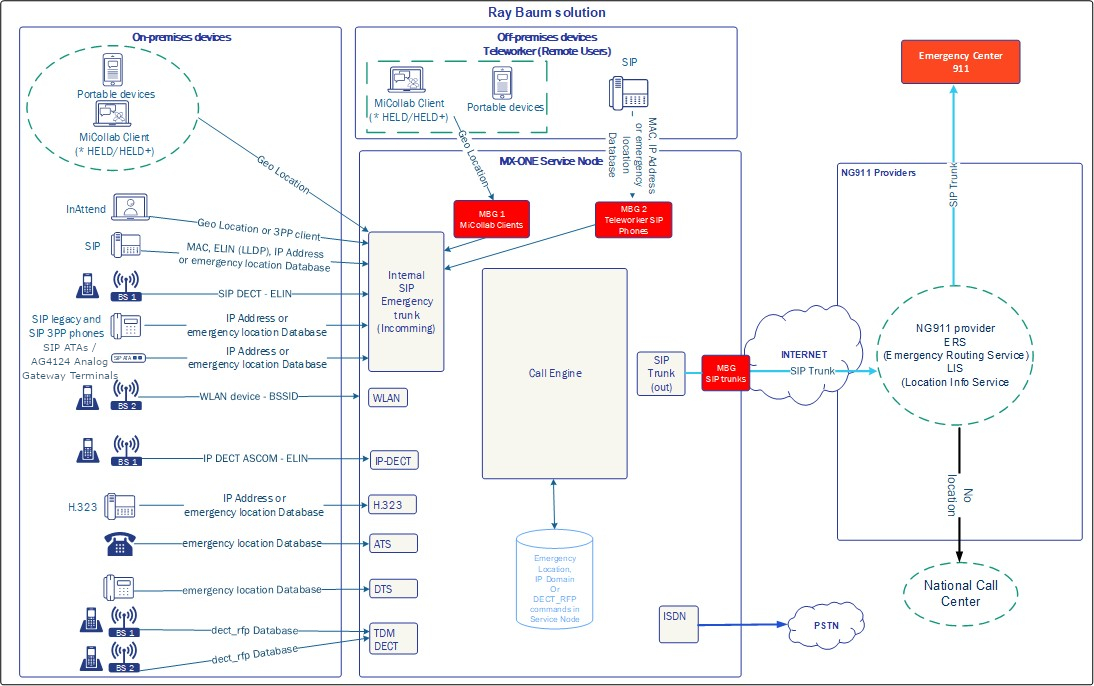
The RAY BAUM solution comprises three main components: devices, MX-ONE, and the NG911 service provider.
Following is a description of these components.
- Devices
The devices are used to initiate an emergency call. Each device needs to provide a unique identifier during the call setup to MX-ONE. The identifiers can be a A-number, Geolocation, BSSID, MAC address, and an ELIN or CESID or an IP address.
The devices must be properly configured by the customer system administrator to provide the required information.
- MX-ONE
The MX-ONE, call manager processes the information received from a device and sends it to the NG911 service provider via MBG.
The information that is sent by MX-ONE depends on the NG911 requirements; it can be:- A 10-digit number
- An identifier such as
ELIN
In MX-ONE, the Location ID (location identifier) is used to provide the ELIN information to the NG911 service provider. The Location ID is defined in MX-ONE via a command.
Note:The MX-ONE RAY BAUM call engine processes the data in the following priority order if multiple input information is provided by the device.
- Geolocation: provided by HELD (HTTP-Enabled Location Delivery) protocol. The devices need to support the HELD protocol.
- BSSID: provided by the 5634 to MX-ONE, the Wi-Fi access point's Basic Service Set Identifier (BSSID) in the SIP INVITE or 200 OK (PANI header).
- MAC Address:
provided by 6700, 6800, and 6900 SIP phones in the INVITE (SIP instance)
– mainly used in Teleworker mode (6800 and 6900). Note:
6700 is not supported in Teleworker mode.
- ELIN or CESID:
provided by SIP-DECT or the IP-DECT in the SIP INVITE or 200 OK
(PAI header), and in SIP Phones (configuration in the network switch).Note:
The device or the base station must support the ELIN or CESID setup.
- IP address
- Emergency Location database, dect_rfp command (TDM DECT).
- Emergency Location database, emergency_location command.
MX-ONE must be properly configured by the system administrator (customer or partner) to provide the required information.
- RedSky - NG911 Service Provider
RedSky providing ERS (Emergency Routing Services) function receives the call setup information from MX-ONE and verifies with the Location Information Server (LIS) that there is a preconfigured valid civic address associated with the device/user before forwarding the call to the correct Public Safety Answering Point (PSAP).
RedSky supplies a web portal where the customer system administrator must set up information about the customer on-premises environment, for example, validated civic address of the building and network information for HELD devices, or any information that could specify a dispatchable location.
Note:If there is no valid location information, the call is redirected by the Emergency Routing Services (ERS) to their National Contact Center to get the location manually. This process may incur an extra cost per call that will be charged to the end-user.
For additional information about the RedSky setup, see the RedSky vendor’s documentation.