Open Numbering Plan or Location Code Based Numbering Plan (Uniform Numbering Plan)
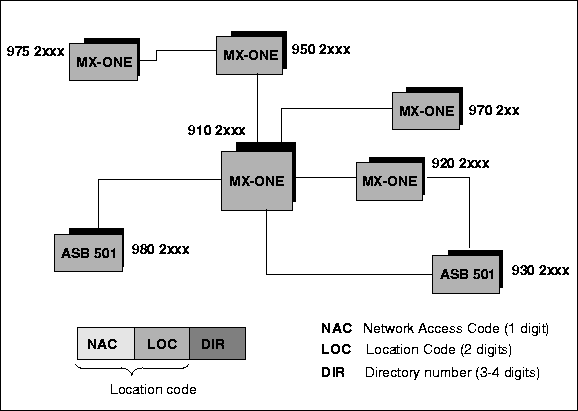
Characteristics for a private network with open numbering plan are:
- Location code (LOC) is used
- The Location code may include a Network Access Code (NAC), (Optional)
- Mixed number length is permitted in the same network. This applies to both location codes and directory numbers.
- Exchanges may have extensions with identical directory numbers.
- The complete dialed number is not always distributed in the network as called number.
- If calling number is possible to send, exchange numbers are used to compose the complete calling number to send.
- If TONs are possible to convey with the calling or connected number, an exchange number table shall be initiated in each of the exchanges for each of the used TONs in order to be able to compose the complete calling or connected number
In MX-ONE, the NAC and the location code are not analyzed separately but handled as one location code.
The external destinations in each of the exchanges are initiated using -numbertype = ed:
number_initate-numbertype ed -number ...
Own exchange numbers are also stated for each node using -numbertype = en.
number_initate-numbertype en -number ...
The route access codes are defined with the command RODDI.
RODDI:DEST=...,ROU=...,ADC=. D2D3D4 .. ,SRT=...
D2 in ADC states the TON for the called number. The TON for the called number is normally used by public exchanges.
D3 states the TON for the calling number public.
D4 states the TON for the calling number private.
The TON values of D3 and D4 , define which exchange numbers to use from the exchange number table together with the directory number when composing the complete calling/connected number.
The exchange number table is built up using command RONDI:
RONDI:ROU=...,EXNOPU=0-(Code for Unknown public);
RONDI:ROU=...,EXNOPU=1-(Code for Country code);
RONDI:ROU=...,EXNOPU=2-(Code for Trunk code);
RONDI:ROU=...,EXNOPU=3-(Code for Network specific);
RONDI:ROU=...,EXNOPU=4-(Code for Local code);
RONDI:ROU=...,EXNOPR=5-(Code for Unknown private);
RONDI:ROU=...,EXNOPR=6-(Code for Local private);
RONDI:ROU=...,EXNOPR=7-(Code for Level 1 Regional);
Note: There is a connection between RODDI and RONDI regarding the ADC parameter values for calling number TON (public and private).
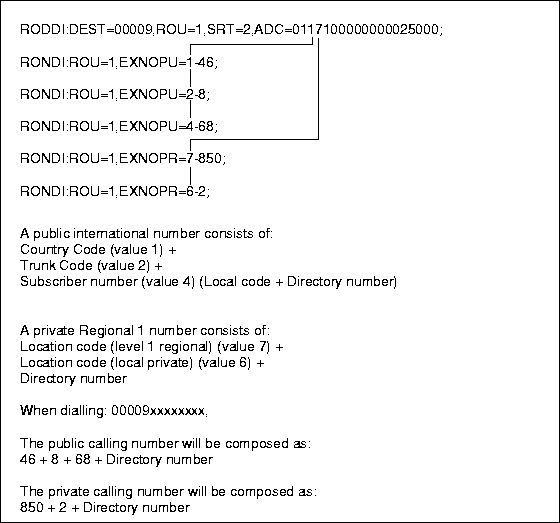
The composed Connected number is defined by received TON of the Calling party number.
In order to make display and network services to work properly, the private exchange numbers that prefix the directory number (stated by EXNOPR in the RONDI command) also have to be initiated as own exchange numbers. This is because if a part of the number is found to be own exchange number, the MX-ONE Service Node removes these parts of the number before displaying or executing a network service.
number_initate-numbertype en -number 'own exchange number (local private exchange number & level 1 Regional exchange number)'.