Call Forwarding
General:
Call forwarding services make it possible for a user to have voice calls forwarded for various reasons, to an answering position within the private network. Call forwarding is only possible in a network with ISDN/H.323 tie lines that supports the Standardized Generic Functional Protocol Interworking Considerations in H.323 Networks. The Call forwarding services described in this document are as follows:
- Call forwarding unconditionally
- Call forwarding on busy
- Call forwarding on no answer
The diverted-to position can be an extension, an ACD group, an internal group hunting group, an individual PBX operator or a PBX operator group.
Prerequisites:
The ISDN/H.323 route must be set with the following data:
- Network services must be set to Yes. Set in parameter SIG in command ROCAI.
- Full ISDN functionality must be set to Yes. Set in parameter VARC in command RODAI.
- Selection of QSIG protocol must be set to include ISO-QSIG. Set in parameter VARI in command RODAI.
- Support of Generic Functional Protocol (GFP) must be set to Yes. Set in parameter VARI in command RODAI.
- The AS parameter, PARNUM = 223, Type of network services has to be set to Call Forwarding.
- Code UUI in Generic Functional Protocol has to be set to Yes, if proprietary UUI signaling is used in the network. Set in parameter VARI in command RODAI.
Execution:
Activation/Deactivation
Procedures to activate/deactivate Call Forwarding are the same as for Call Diversion.
Basic Traffic Concept:
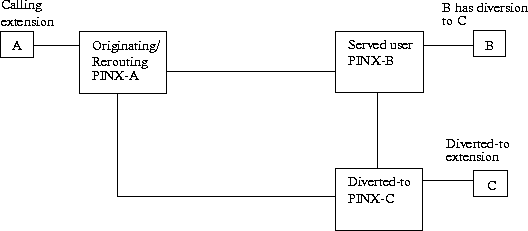
To minimize occupied network resources the call always returns to the originating PINX when a diversion is detected in served user PINX. The originating PINX then proceeds with the new call setup to extension C in the diverted-to PINX.
However, forward switching from the served user PINX can be started, depending on a VAR parameter value in the RO command. In such a scenario, the served user PINX shall proceed with a new call setup to extension C in the diverted-to PINX.
Multiple Call Forwarding in Network:
The function for multiple Call forwarding is the same as for chaining of network diversion.
The maximum number of diversions that is allowed for one call is set by the diversion_system command, in served user PINX. A counter, placed in the originating PBX, is increased each time a new Call forwarding is encountered and it is compared with the value set in the chaining parameter. If the counter equals the value set in the chaining parameter, actions depending on the originating Call forwarding reason will take place. The actions to take place are the same as for Call diversion.