When Communication Becomes a Compliance Liability
A regulator doesn't ask whether your team followed protocol. They ask whether you can prove it. In healthcare, that distinction is where compliance gets expensive.
Get instant access to the asset by clicking the button below
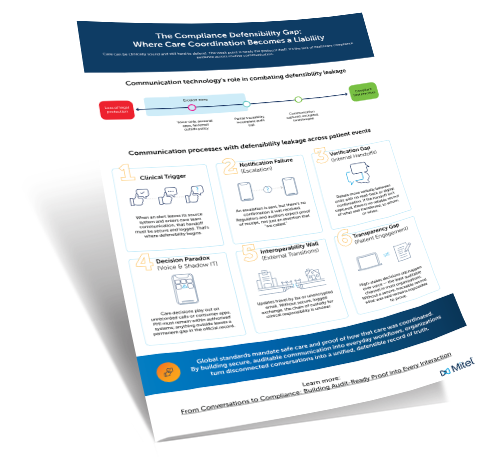
DownloadThe six failure points mapped below share a common thread: they're communication problems that became documentation problems after the fact. An escalation with no confirmation of receipt, or a handoff that happened verbally, between units, with nothing captured, or a care decision made on a consumer app that was never designed to hold PHI. Each one leaves a gap in the record. These are the gaps that auditors are looking for.
The Least Traceable Channel
Voice remains the primary pathway for clinical decisions during high-pressure events. It is also the least traceable. Most organizations have reasonable controls around messaging and email, but voice calls often leave no auditable trail at all. Unfortunately, that channel is where critical escalations, handoff instructions, and care decisions actually travel. This is clearly a compliance posture that hasn't caught up with how care is delivered.
The same applies to external transitions. When updates move by fax or unencrypted email across facility boundaries, the chain of custody for clinical responsibility becomes genuinely unclear, in the sense that no one can say with confidence what was communicated, when, or whether it was received.
Compliance Built into the Workflow
The organizations best positioned for audit are the ones generating evidence continuously, as care happens. That means communication infrastructure designed to capture and surface interactions across voice, messaging, and video, in a manner that’s secure and automatic, without adding burden to clinical staff.
Distributed care models and hybrid staffing have made this harder. Teams span locations and shifts, and handoffs cross systems that weren't necessarily designed to talk to each other. The communication layer has become the most fragile link in the compliance chain, and in most organizations, it's still the least monitored.
Global standards increasingly reflect this reality. Safe care and proof of how that care was coordinated are now treated as inseparable. The question for healthcare leaders isn't whether communication needs to become a compliance asset. It's how quickly that shift can happen before the next audit request lands.
Six Points Where the Record Breaks Down
The failure points illustrated here map the moments in a patient event where communication leaves the controlled environment: where an alert crosses into an unlogged channel, where a handoff travels by word of mouth, and where a decision gets made on a device that was never authorized to carry it.
Individually, each represents a manageable risk. Together, they describe an organization that cannot fully reconstruct what happened, to whom, or when. That's more than a compliance gap. That's a liability.