Digitize the front door. Transform the experience for patients, clinicians, and staff.
When a patient calls and is greeted by name — that's the outcome. Mitel deeply integrates into healthcare workflows to increase patient autonomy, improve end-to-end processes, and give your teams back the time they spend navigating systems and asking patients to repeat themselves.

The Outcomes That Matter
Better experiences. Fewer wasted minutes. More time for care.
66% of frontline healthcare workers say communication issues delay them in completing tasks.* Patients navigate multiple systems per interaction and repeat their information at every step. Mitel deeply integrates into the healthcare workflows that sit behind these moments — so patients feel known, staff stay focused, and your organisation sees measurable time and cost savings from day one.
*Vanson Bourne, 2026, The State of Workforce Communications
Benefits for Healthcare Teams

Saved per inbound call
5 hrs/day admin productivity gain

Reduction in call volume
AI self-service handles routine patient tasks

Reduction in no-shows
Recovered revenue & clinical capacity
Three capabilities. Measurable impact across the patient journey.
A patient greeted by name. A routine task completed without a hold. A reminder that arrives before the patient thinks to call. These are the outcomes — enabled by three integrated capabilities that connect directly to your healthcare workflows.
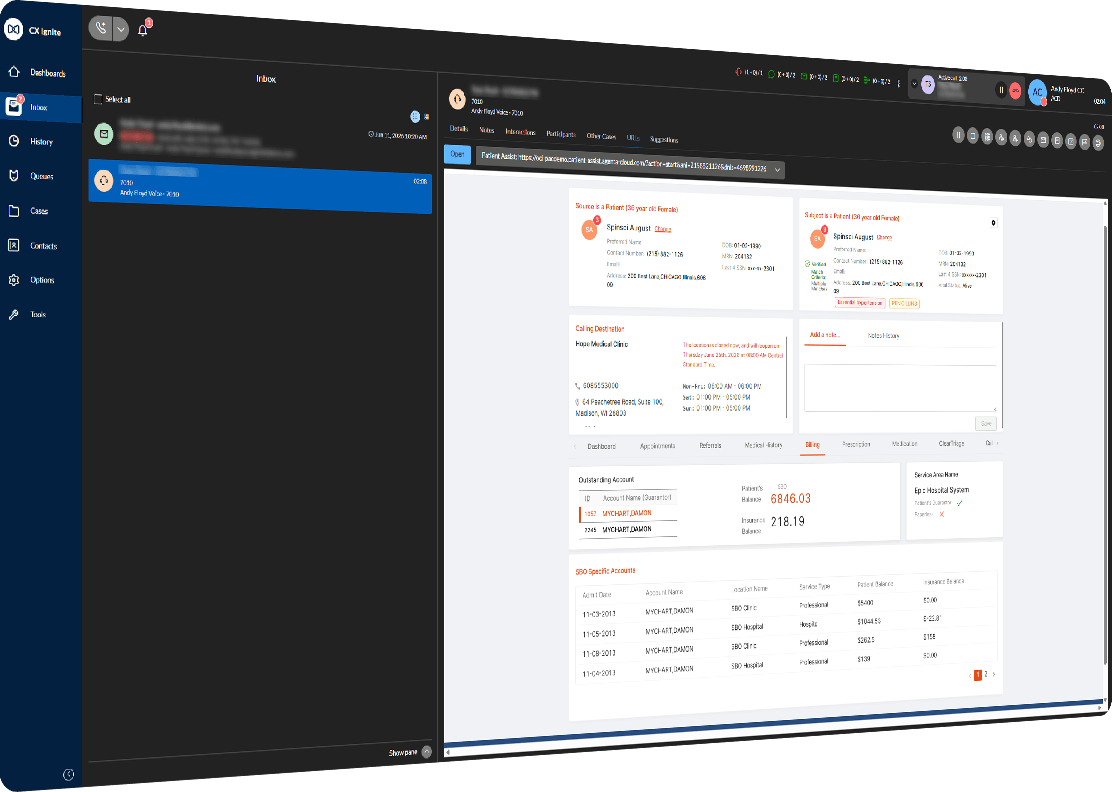
Patient intelligence on every call
-
Admin staff receive a full patient screen pop the moment a call connects — demographics, appointments, prescriptions, and billing balance, pulled live from the EHR.
● Caller matched to EHR in real time
● Notes written back to the record automatically
● Works for agents, nurses on SIP-DECT Sets, and coordinators in MiCollab✓ 43 seconds saved per call
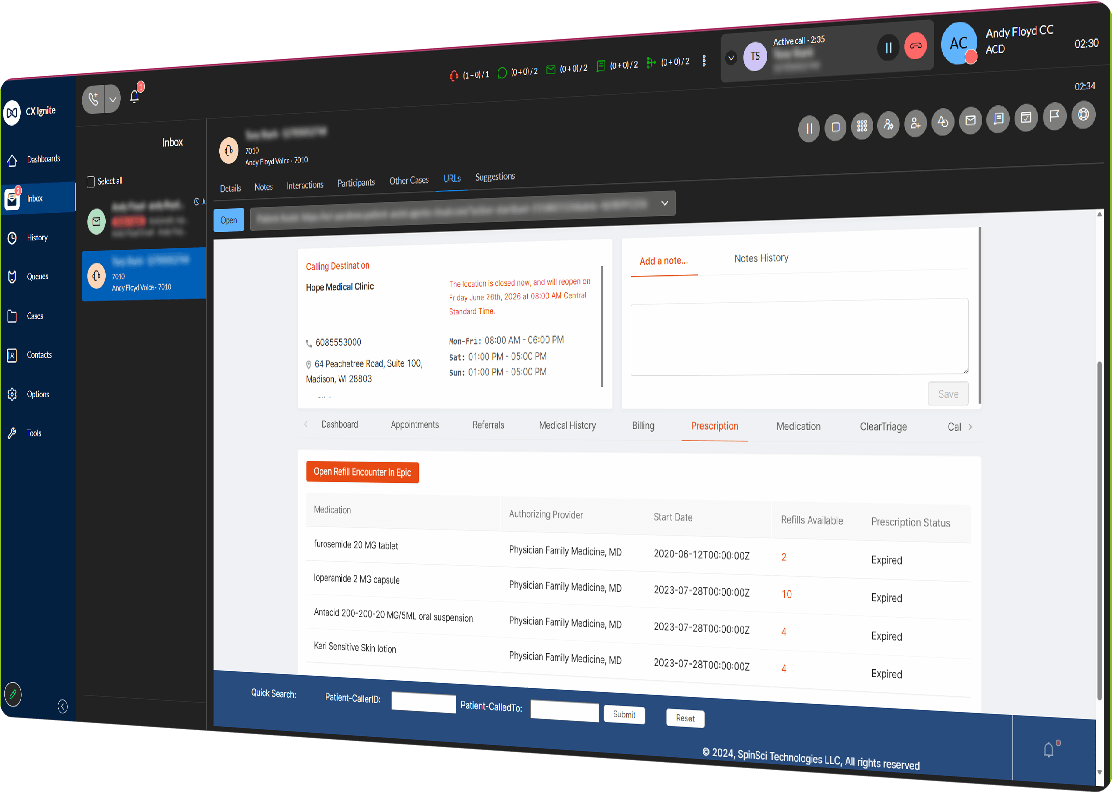
Patients handle routine tasks 24/7
-
An intelligent IVR, powered by live EHR data, lets patients manage appointments, pay bills, and request prescription refills without reaching a staff member.
● Appointment scheduling and cancellation
● Secure bill payment by voice or SMS
● Prescription refill requests to pharmacy✓ 65% call volume reduction
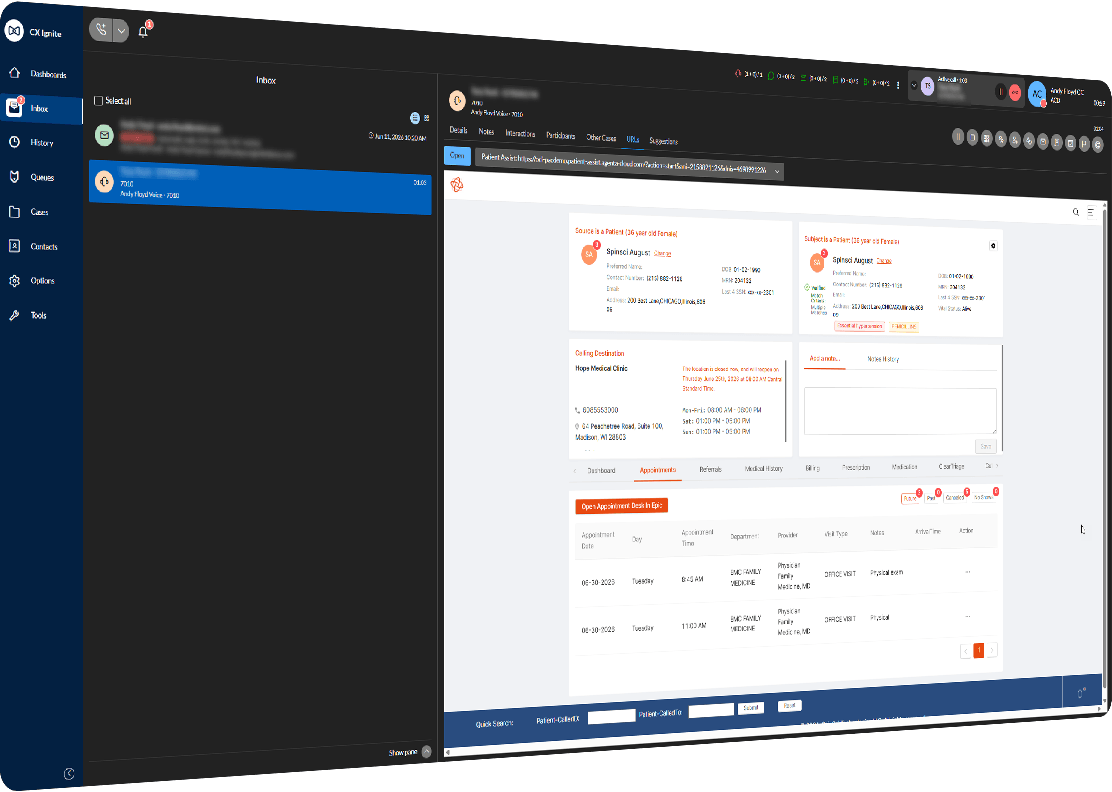
EHR-triggered outreach, automatically
-
Multi-channel notifications — voice, SMS, email — triggered directly by EHR events and delivered by OpenScape Alarm Response. Reminders, billing alerts, and prescription ready notices reach patients before they need to call.
● Appointment reminders with confirm/cancel
● Billing and payment notifications
● Two-way responses captured in the EHR✓ 51% fewer no-shows
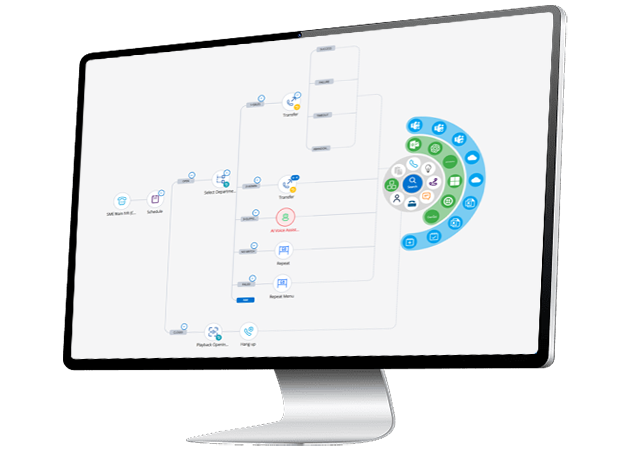
Customise further with Workflow Studio
-
Common workflows come packaged and ready to deploy. Anything specific to your department, your team builds directly in Workflow Studio — a no-code canvas that connects the EHR to phone, messaging, and alerting on your own timeline.
- Packaged workflows for pharmacy, billing, referrals, and more
- No-code builder for anything not yet templated
- Runs on the voice infrastructure you already have
Healthcare workflows, ready to deploy.
Common patient interactions — handled, automated, and connected to your EHR from day one.

Appointment scheduling
Patients confirm, cancel, or reschedule via IVR or SMS. Staff see full context on screen pop.
Screen pop | Self-service IVR | Reminders
Pharmacy & prescription refills
Automated refill requests to pharmacy. Ready alerts pushed to patient by SMS or voice.
Self-service IVR | Ready alert
Billing & payment
Patients check balances and make secure payments by phone or SMS, without staff involvement.
Screen pop | Self-service IVR | Bill notification
A Day in The Workflow
Scenario
A patient calls about a recent appointment. The admin needs to verify identity and understand the reason for the call — before saying hello.
Without integration
Staff ask the patient to hold while they search the EHR manually — adding 40–90 seconds to every call.
How it works with Mitel
- Inbound call detected — caller matched to EHR record in real time.
- Full screen pop delivered before the call connects: name, appointments, prescriptions, balance.
- Admin greets the patient by name, verifies identity instantly, addresses the query.
- Call notes written back to EHR automatically — no duplicate entry.
Value
- 43 seconds saved per call
- Faster verification and resolution
- Staff free to focus on complex needs
Scenario
A patient calls at 7pm to reschedule a follow-up. No staff are available, but they need confirmation before morning.
Without integration
Call goes to voicemail. The clinic arrives to a backlog of callbacks the next day.
How it works with Mitel
- IVR answers immediately and identifies the patient from their caller ID.
- System queries the EHR for the patient's current appointments and available slots.
- Patient selects a new time. Change written to EHR. Confirmation SMS sent.
- Patient hangs up satisfied. No staff involved.
Value
- 24/7 self-service availability
- Eliminates after-hours callback backlog
- 65% reduction in inbound call volume
Scenario
A clinic loses 18% of appointments to no-shows each month, costing revenue and clinical capacity.
Without integration
Manual reminder calls are inconsistent and disconnected from the EHR — they can't adapt when appointments change.
How it works with Mitel
- EHR event triggers automatic reminders 72 and 24 hours before each appointment.
- Patient receives a voice call or SMS with live appointment details.
- Patient confirms, cancels, or reschedules — response written back to EHR immediately.
- Cancelled slots flagged for rebooking. Clinical team recovers capacity without manual review.
Value
- 51% reduction in no-shows
- Recovered clinical capacity and revenue
- Zero staff time on routine reminders
Scenario
A patient calls to question a balance. The billing admin needs to pull the account and explain charges.
Without integration
Admin places the patient on hold to search billing manually. For routine queries, this is pure friction.
How it works with Mitel
- IVR offers a self-service billing option before the call reaches a staff member.
- Patient authenticates and retrieves their balance, recent charges, and payment history.
- Patient pays securely in the same call if they choose.
- Complex disputes routed to a specialist — with screen pop already loaded.
Value
- Routine billing queries resolved without staff
- Reduced hold times and abandoned calls
- Improved revenue cycle management
Scenario
A patient needs a monthly prescription refilled. Previously this meant a call, a hold, a message, and a callback.
Without integration
High-volume, low-complexity refill calls consume significant admin time and generate disruptive callbacks.
How it works with Mitel
- Patient calls or texts. IVR identifies them and presents their active prescriptions.
- Patient selects the medication. Refill request sent directly to the pharmacy workflow.
- When ready, an automated notification is pushed to the patient.
- Adherence reminders sent automatically for long-term medications.
Value
- Zero staff time for routine refills
- Improved medication adherence
- Proactive ready-alerts reduce repeat calls
What Executives and Clinical Operations Leaders Ask Us Most Often.
-
Your EHR is your system of record — it holds everything. But it was never designed to manage how patients and staff communicate. Every time a patient calls, a staff member has to search for the record. Every reminder has to be sent manually. Every refill request goes through a person. Mitel connects the communication layer to the EHR — so the data your team already enters drives automated, intelligent interactions without adding work. Think of it as activating what your EHR already knows.
-
The opposite. Staff see less — not more. When a patient calls, the record appears automatically. Routine tasks like appointment reminders and prescription refills are handled without staff involvement at all. The goal is to reduce the number of systems your team has to navigate, not add to them. For clinical staff, that means fewer interruptions. For admin teams, that means fewer calls to answer and fewer manual entries to make.
-
Measurable impact typically begins from the moment the first workflow goes live. Appointment reminder automation reduces no-shows in the first appointment cycle — often within weeks of deployment. Screen pop time savings are immediate and visible on day one. Organisations typically see the full picture of ROI — across call volume, staff productivity, and revenue cycle improvement — within the first quarter of operation.
-
Yes. Mitel's integration is designed to connect to your existing voice environment — whether that's on-premises, cloud, or a hybrid of both. There is no requirement to replace your current phone system or migrate everything to a new platform. The integration layer sits between your communications infrastructure and your EHR, activating the data without disrupting the systems your teams depend on every day.
-
Patient data security is built into the architecture, not added as an afterthought. The integration connects to your EHR within your existing security perimeter — patient information is surfaced to authorised staff in real time and is not stored or replicated outside your controlled environment. Mitel's healthcare solutions are designed to support HIPAA compliance requirements. Your IT and compliance teams will be involved in the implementation scoping to ensure all data handling aligns with your organisation's policies and regulatory obligations.
-
No — and for most organisations, a phased approach makes more sense. Many start with screen pop, since it delivers immediate, visible value to every staff member who handles inbound calls and requires the least change to existing workflows. Self-service IVR and proactive notifications can follow in sequence, each building on the data connections already established. Your Mitel specialist will help you map a deployment sequence that aligns with your clinical priorities, IT capacity, and change management approach.