Before a patient even sees a clinician, they've already formed an opinion about the quality of their care. That opinion was formed in a queue, or in an IVR loop, or while waiting on hold long enough to wonder whether anyone was going to pick up on the other end.
That’s precisely the problem that keeps surfacing in conversations with healthcare leaders: investment in patient experience is concentrated at the point of care, while the experience that shapes patient trust happens in the minutes before any clinical interaction begins. And most healthcare communications infrastructure simply wasn't designed with that in mind.
That misalignment used to be a quality problem. It's becoming a revenue problem. As value-based care models take hold in the US, the business case for keeping a patient engaged over years of care means the relationship has to start at the first point of contact, and hold.
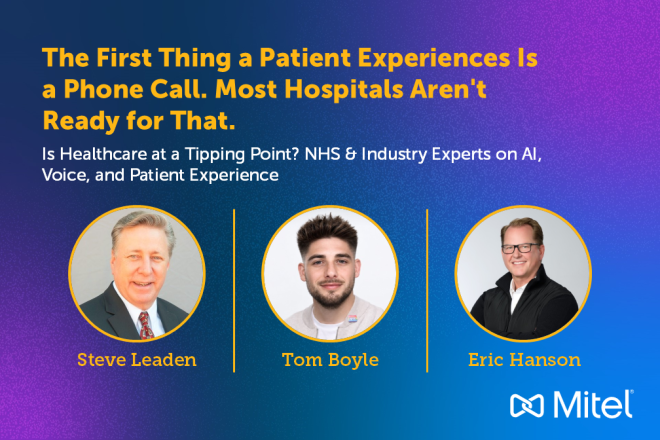
The commercial pressure differs in the UK, but the underlying dynamic is the same. Tom Boyle, who manages digital communications for NHS Sheffield, couches the problem in human terms: people waiting for care in the UK are "more anxious than ever," he says. When they finally reach out, the quality of that first contact — whether they feel heard, whether they're routed correctly, whether someone can explain what the letter they’ve received actually means — determines whether they show up for the appointment at all. Miss that moment, and you've shaped a perception that no amount of clinical excellence can fully undo.
Healthcare communications consultant Steve Leaden has seen the same dynamic play out in the US, with blunter commercial force. A six-hour outage cost one of his healthcare clients $1 million in lost revenue. But the cost in patients who don't rebook, don't re-engage, or who don't trust the system enough to return is significantly larger.
Why Voice Is Still the Front Door
For years, the prevailing assumption in communications strategy was that voice would gradually give way to digital channels. Patients would prefer to book online, message asynchronously, or interact with portals. Voice would shrink to an escalation path for complex cases.
That hasn't happened, and healthcare is one of the clearest examples of why.
As Leaden sees it, the explanation revolves around relationship- and trust-building: "There has to be not just a patient experience, but a personal experience with that patient," he says. Healthcare interactions are, by nature, emotionally loaded. A patient calling about a symptom, a confusing diagnosis, or an appointment they're nervous about is not looking for a transaction. They're looking for reassurance that someone on the other end understands the weight of what they're going through.
Boyle makes the same point in the context of NHS Sheffield's operational reality. Post-COVID, the NHS saw a surge in patients trying to re-enter a system they'd avoided during the pandemic. Their primary channel was the phone. The result: thousands of simultaneous inbound calls hitting infrastructure that was never sized for that volume, under conditions where a poor experience directly correlated with a missed appointment and a patient sliding back off the list.
The lesson is that voice is the highest-stakes interaction most healthcare organizations manage, and it's often the most underinvested.
The Infrastructure Question Behind Every Patient Experience Conversation
Once you accept that the first contact matters as much as the clinical interaction, the infrastructure question is really shaped by a focus on what architecture gives you the control to make that first contact count, and the resilience to make sure it happens in the first place.
Leaden described a transformation underway at a large US health system: 16,000 endpoints, 10 hospitals, nearly 100 clinics, all being redesigned around the idea of a "single virtual building," where any staff member can reach anyone else in the network with a short internal dial. The goal is to create the kind of connected culture that patients can actually experience: calls that don't dead-end, transfers that land correctly, staff who can find answers without putting a patient on hold for four minutes while they track down a different department.
In the UK, Boyle described an analogous shift in the NHS toward a "neighborhood" model consisting of multiple trusts operating their communications infrastructure as an interoperable network rather than isolated silos. The practical obstacle is familiar: some organizations in the network are further along than others, and standardizing at scale means either waiting for everyone to catch up or accepting a patchwork that doesn't fully deliver on the promise.
What both scenarios share is the recognition that communications infrastructure is the connective tissue of patient experience, and the lens through which every other investment in care quality is either realized or undermined.
This is what makes AI the next, and most consequential, variable in that equation. If the infrastructure is the foundation, AI is what most healthcare organizations are now being asked to build on top of it, often before the foundation is ready.
AI Works in Healthcare When It Earns the Right to Be There
The pressure to deploy AI in healthcare communications is producing predictable results: organizations are moving fast, implementing broadly, and discovering that rushed deployment actively damages patient trust.
Leaden cited Gartner's projection that 60% of AI projects will fail in 2026, and identified the root cause: organizations implementing before they've defined success, or scaling before they've validated in a contained environment.
An implementation he's currently working on stands in contrast as a model that pays off: AI handling prescription refills and appointment scheduling, tightly integrated with the patient record and a controlled rollout. It's working because the use case is specific, the data is clean, and the scope was kept narrow enough to measure.
Boyle's perspective is that it’s essential to get it right the first time. In healthcare, a bot that doesn't understand a patient's question, or routes them incorrectly, or fails to recognize distress, doesn't just create a bad interaction. It tells that patient something about the care they're about to receive. And for patients who are already anxious, already waiting too long, already uncertain, that signal is particularly intense.
The AI applications that are delivering value in healthcare communications right now are narrow and operational. They’re handling routine inbound requests, surfacing real-time prompts for contact center agents, and reducing the administrative call volume that pulls clinical staff away from patients who need them. These are repeatable at scale, and in healthcare, repeatability is trust.
And repeatability, it turns out, depends entirely on where and how the underlying infrastructure is built. Which is why the AI conversation and the hybrid infrastructure conversation are really one and the same.
The Right Architecture Is the One That Matches the Stakes
To answer the hybrid infrastructure question in healthcare, it helps to reframe it around risk rather than preference.
Both Boyle and Leaden are running cloud-based contact center environments today. Neither is arguing for a return to fully on-premises everything. The guideline they work from is simple: not every workload in a hospital carries the same failure cost.
For instance, a clinic managing routine outpatient appointments can absorb the tradeoffs of a cloud dependency. If the system has an issue at 2pm on a Tuesday, appointments get rescheduled and no one is in danger. But a crash team call from inside the hospital cannot make that calculation. When there's no dial tone and a patient is in cardiac arrest, you need to know within minutes what broke and how to fix it. That's only possible when the system is yours and the failure modes are finite.
What this produces in practice is architecture segmented by criticality: on-premises or private cloud for the high-stakes environments where control matters most, and cloud-based layers for the contact center and clinic functions where scalability and flexibility justify the tradeoff. Boyle made the scalability case within the optic of an event such as COVID, when hospitals couldn't spin up contact center capacity fast enough because their infrastructure didn't allow it. A cloud-enabled contact center layer means the next surge, whatever its cause, can be absorbed without a capital project.
So the question isn't "to cloud or not to cloud." It's "which workloads can we afford to hand over control of, and which ones need to stay in our hands?" Healthcare organizations that have thought through that question are building architectures that hold up under pressure.
What's at Stake
The patient relationship can't start at the appointment. It has to start at the first point of contact, and it has to be strong enough that the patient wants to maintain it.
This changes what communications infrastructure needs to do. A system that handles inbound calls efficiently is not the same as a system capable of sustaining ongoing, personalized relationships with patients across years of care. But the gap between those two types of systems is where most healthcare organizations currently live.
The technology to close the gap exists. The architecture decisions that make it possible are well understood. But patients don't experience technology strategies or architecture considerations. They experience whether someone answered the phone, understood their question, and made them feel like the system was built for them.
Mitel helps healthcare organizations design communications architectures built for clinical reliability, patient experience, and the capacity to scale when it counts. Talk to a specialist about where your infrastructure stands.