Virtual Care Collaboration Service

Benefits of Virtual Care Collaboration Service (VCCS)

Deployment Flexibility
While the solution exploits born-in-the-cloud technologies, VCCS is equally at home in on-premises and hybrid models.This makes VCCS the perfect option for the demands of public and private providers who need to satisfy rigorous country regulation and maintain data sovereignty.

No downloads required
VCCS exploits WebRTC technology to provide high-quality interactions on the most convenient device, regardless of location.This enables encrypted e-consultations without the need for client downloads, installation or management.

Innovative possibilities
VCCS is designed with integration in mind - unlocking infinite possibilities for providers thinking beyond e-consultation. VCCS is capable of medical and consumer device integration, augmented-reality enabled clinical encounters, e-consent for clinical trials and supporting expert training needs.
- Healthcare Communications
Care that's always connected.
HIPAA-ready calling, secure messaging, and reliable contact center for every shift.

Suitable for all organisations
Whether on-premises, hybrid or secure cloud deployments – VCCS meets the telehealth demands of many healthcare provider scenarios without imposing wholesale change – adding value and efficiency to existing workflows and applications through flexible integration capabilities.
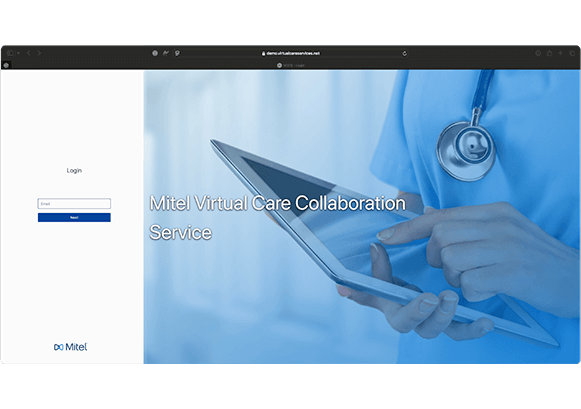
Orchestrated efficiency
VCCS design principles make it ultra versatile and ready for use in many aspects of patient-centric virtual care.From proactive and preventative care, remote e-consultation and triage, from inpatient stays to community care and recovery – VCCS helps efficiently orchestrate providers staff, patients and resources with an integrated scheduling view.
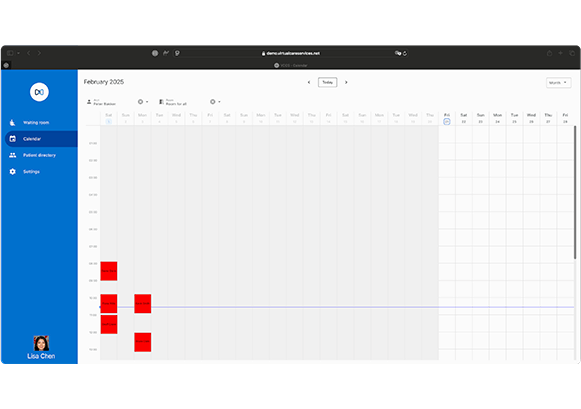
Privacy and security measures
Protecting patient privacy is vital.VCCS allows patients and staff to communicate securely via video, audio, screen-sharing, messaging and secure file transfers. Encryption is built-in to ensure confidentiality is maintained and importantly – does not require a client application to be downloaded, installed or managed.
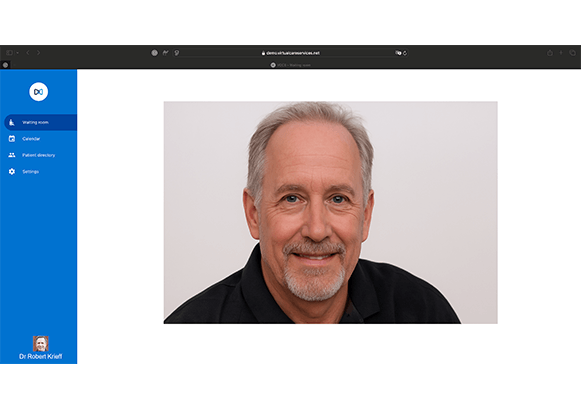
Patient coaching overlays
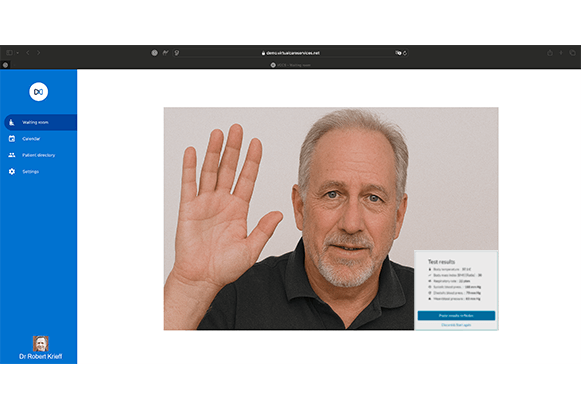
Medical and expert staff can receive visual cues and reminders of historic patient conditions and symptoms from the patient record system – these appear as overlays in real-time, providing useful background details for on-going diagnostics and continued care.
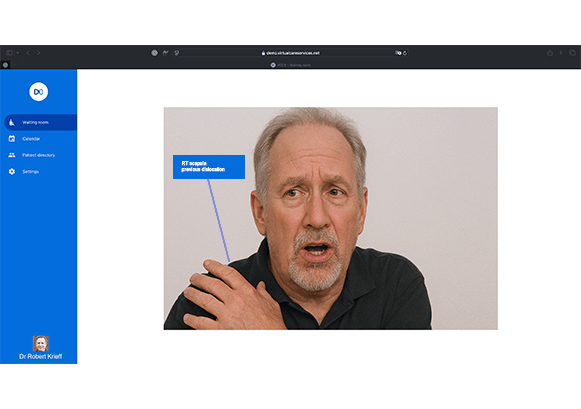
Telehealth e-consultation aids
Medical staff can conduct remote examinations (with patient consent) – Images and notes can be recorded and stored. Additionally, medical and patient device data can be securely uploaded - such as temperature, respiratory rate, pulse oximetry and blood pressure for clinical decision support purposes.
- Frost & Sullivan Healthcare Report
Building Trust and Reliability in Healthcare Communication Systems
Read Frost & Sullivan’s 2025 Report on Communications Transformation in Healthcare.
Features
- Supports all deployment types (On-premesis, hybrid and secure cloud)
- Secured video, audio, messaging, screen and file sharing
- Encrypted multi-modal communications with no downloads required
- Join from almost any location or device - browser, smartphone or tablet
- Orchestrate people and resource efficiency with calendar scheduling
- Highly versatile integration capabilities support future demands
- AI Transcription delivers more focused interactions and increased efficiency of expert resources
- AI meeting summarisation uses prompt engineering to define formatted output for tight integration
- Proxmox VE support enables greater choice of virtual environments with lower operational costs
We Are Here To Help
Document Center
Your go to place for technical documentation about Mitel platforms, devices and technologies.
Learning Center
Unlock the full potential of your Mitel products with a suite of Mitel tutorials, courses, and videos.
Technical Support
Global technical support for customers, service providers and partners.
Virtual Care Collaboration Service Frequently Asked Questions
-
Healthcare organizations have invested heavily in telehealth capability, only to find adoption constrained by a persistent obstacle: patients are required to download and install an app before a consultation can begin. For elderly patients, those with limited digital confidence, or anyone accessing care on an unfamiliar device, that step is often enough to cause a missed appointment.
Mitel's Virtual Care Collaboration Service (VCCS) is a browser-based virtual care platform. No downloads are required for patients or care team members. Patients join through a secure link, directly from any modern browser. Clinical staff initiate or join consultations from their existing workstation or mobile device. The platform supports secure video and audio consultations, remote patient monitoring integration, AI-assisted transcription and summarization, and flexible scheduling. It can be deployed in secure cloud, on-premises, or hybrid configurations to match your organization's data sovereignty and compliance requirements.
-
Patient app adoption is consistently one of the top barriers to telehealth program effectiveness. When a patient receives a consultation link and encounters a download requirement, the friction is often enough to prevent the appointment from completing — particularly for older patients and those with limited connectivity or technical support.
The Virtual Care Collaboration Service is fully browser-based. Patients join consultations directly through a web link — no app installation, no account creation, no device configuration required. This works across Chrome, Firefox, Safari, and Edge on both desktop and mobile devices. For healthcare organizations, this means more completed appointments, fewer no-shows attributable to technical friction, and a more accessible experience for patients across the full range of digital confidence levels. Clinical staff use the same browser-based interface, which reduces training requirements and technical support overhead on the provider side as well.
-
Healthcare organizations operate under different data management requirements depending on their regulatory environment, geography, and existing IT infrastructure. A single deployment model rarely fits across the full diversity of healthcare organization types and sizes.
The Virtual Care Collaboration Service supports three deployment models: secure cloud hosting for organizations that prefer managed infrastructure and rapid deployment; on-premises for organizations that need full control over where patient data is processed and stored; and hybrid configurations that distribute workloads based on specific requirements. Proxmox VE virtualization support provides an additional infrastructure option that can reduce operational costs for organizations with existing virtualization environments.
This flexibility means organizations can start in the cloud and move toward on-premises control as compliance requirements or organizational priorities evolve — without replacing the platform. Specific compliance configurations and deployment requirements should be reviewed with Mitel's healthcare team during evaluation.
-
Documentation burden is one of the measurable contributors to clinician burnout. Time spent on post-visit notes — often after scheduled hours — is time that isn't available for patient care. AI-assisted transcription addresses this directly by capturing consultation content in structured form during the interaction itself.
The Virtual Care Collaboration Service includes AI transcription that records and structures consultation content in real time. AI meeting summarization uses prompt engineering to generate formatted output that can be integrated into EMR systems, reducing the need for manual post-visit documentation. For clinical teams, this means less administrative overhead after visits, more focused consultations, and faster availability of structured notes for continuity of care.
For organizations evaluating the return on virtual care investment, reduced documentation time per provider is a concrete, measurable productivity gain — alongside the appointment completion improvements that come from removing the app download barrier.