Two years ago, a global bank faced a dilemma: modernize its communications or risk compliance penalties in three regions. The solution, it turned out, wasn't a bigger cloud. It was a hybrid Unified Communications and Collaboration (UC&C) architecture combining on-premise control with cloud flexibility and scalability.
This scenario is no longer a rarity, and UC&C platforms are no longer "just" about enabling conversations. Emphasis has shifted from UX and cloud flexibility to optimizing business productivity, efficiency, and control and resiliency, in what is essentially a reimagining of business continuity.
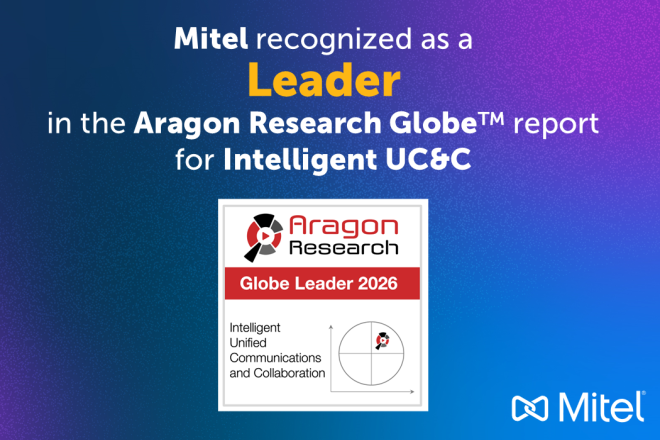
And with Mitel being positioned as a leader for advancing hybrid + AI-first strategies in Aragon Research's 2026 Globe for Intelligent Unified Communications and Collaboration, it's become clear that enterprise-grade automation and compliance are the real anchors of UC&C long term enterprise success.
The New Reality: UC&C as a Strategic Asset
UC&C platforms have evolved from basic voice and video tools into the anchor for human and AI agent collaboration. And where the previous generation of intelligent assistants provided reactive support in the shape of meeting summaries and call routing, today's AI agents are different. They're autonomous digital workers executing multi-step processes.
As AI agents take on regulated workflows, the focus of orchestration is really on enforcing compliance rules at every step. This is what enables efficiencies in highly regulated sectors.
For example, in healthcare, an AI agent can verify insurance eligibility, schedule follow-up appointments, and update patient records across three systems, without human intervention. In finance, agents reconcile transactions, flag anomalies, and escalate exceptions to compliance teams.
The outcomes of shifting from assisted tasks to orchestrating digital and human resources are what makes UC&C infrastructure so strategic to enterprise:
- Customer experience (CX) improvements: AI assistants and agents reduce wait times, personalize interactions, and keep conversations consistent across channels.
- Productivity and efficiency: Automating multi-step workflows cuts manual effort, accelerates response times, and frees human teams for higher-value work.
- Cost optimization: Consolidating siloed tools into a unified platform lowers licensing complexity and reduces overhead for managing multiple systems.
But these capabilities only deliver value at scale when they run on infrastructure that meets data sovereignty, compliance, and security mandates.
According to Aragon Research, public cloud often falls short on those requirements. Cloud-only models offer simplicity and rapid deployment, which works well for companies with straightforward compliance needs and high cloud risk tolerance. This approach introduces constraints, however: limited control over data location, dependency on a single vendor's security posture, and challenges integrating legacy systems that can't (or won't) migrate.
As CX teams expand to include both digital and human talent, , enterprises need infrastructure that can scale globally while meeting strict security and data residency requirements. In a world of hybrid talent, hybrid infrastructure delivers that balance.
"The market for cloud services has now shifted to hybrid, with private and sovereign cloud playing a central role," said Jim Lundy, CEO, Lead Analyst, Aragon Research. "Enterprises want flexibility, but not at the expense of trust, transparency, or control over their data."
For enterprises operating across multiple regulatory regimes, or those with on-premise investments that still deliver value, cloud-only creates friction. Hybrid UC&C provides the flexibility and control enterprises need to make automation deliver real value.
Far from being the transitional state portrayed by cloud-only vendors, hybrid has always been the foundation for compliance and scalability, especially as AI permeates every UC&C workflow, extending beyond assistants to generative agents reshaping meetings and workflows.
And now, sovereign cloud is reshaping the conversation. Aragon's report notes that what used to be a niche concern—keeping data within national borders—is becoming non-negotiable for regulated industries.
Sovereign cloud ensures data stays in-country, satisfying privacy laws and geopolitical risk concerns without sacrificing scalability. For defense, healthcare, and finance, this is essentially a survival requirement.
Mitel's Role in the Hybrid Era
Mitel was named a Leader in Aragon Research's 2026 Globe for Intelligent Unified Communications and Collaboration, and this underscores our commitment to the reality of the hybrid era.
In fact, the key differentiators below address critical enterprise requirements that most UC&C vendors struggle to combine in one platform. Mitel stands out as the only vendor combining secure hybrid deployments with advanced AI orchestration, enabling automation without disruption.
- Mitel CX: An AI-powered and hybrid-ready contact center that enables enterprises to deploy advanced automation without sacrificing control over where data lives. Most competitors force a cloud-only model.
- Secure cloud options: Hybrid and Sovereign Cloud models designed for strict data residency laws. Sovereign Cloud ensures compliance with strict data residency laws, which is a growing mandate in finance, healthcare, and government sectors. Few providers can deliver this flexibility at scale.
- Defense-grade security: JITC-certified OpenScape Voice for government and critical infrastructure in high-consequence environments where security is non-negotiable.
- Workflow Studio: Intelligent orchestration engine that lets business analysts build AI-driven workflows across UC, CX, and adjacent technologies that power critical business processes, without needing to rely on developers. Instead of writing custom code or stitching together APIs from multiple vendors, users drag and drop logic blocks to create automation: route customer calls based on sentiment analysis, trigger alerts when certain keywords appear in conversations, or automatically escalate cases that exceed wait-time thresholds. This visual approach eliminates months of custom development and the ongoing maintenance burden that comes with it.
What underpins this solution set is our commitment to enabling resilient operations, in industries where downtime or data exposure are untenable options.
The Bottom Line
In 2026, the winners will be those who treat UC&C as a strategic automation hub driving compliance, efficiency, and AI-powered innovation.
But its hybrid UC&C is what will characterize the truly future-ready enterprise.
That's because hybrid deployment models allow enterprises to:
- Control sensitive data while still benefiting from cloud scalability.
- Meet regulatory requirements in sectors like healthcare, finance, and defense.
- Integrate legacy systems without forcing a disruptive rip-and-replace migration.
Learn more: Download Aragon Research's 2026 Globe for Intelligent Unified Communications and Collaboration.