When we set out to design the Mitel Vibeathon, the goal was simple but ambitious: to create space for exploration, learning, and hands-on experimentation with AI. Innovation Day remains Mitel’s annual moment to showcase and celebrate innovation across the company. The Vibeathon created a different kind of space: a company-wide sprint designed to help employees learn by doing, test ideas quickly, and experience how AI can lower the barrier between problem and prototype.
In previous summers, we typically ran a hackathon within the R&D organization, with ideas often feeding into Innovation Day. This year, we took a different approach: we opened the format to the whole company and shifted the emphasis from producing showcase-ready concepts to creating a hands-on learning experience around AI.
Over two days in June, 382 people forming 190 teams identified real problems from their day-to-day work, shaped ideas, and built functioning prototypes. Most had never built a software prototype before.
Here is what we learned.
Why we built it the way we did
Traditional hackathons tend to attract the same people: developers, product managers, technical leads. The format rewards prior experience with the tools and creates a quiet barrier for everyone else.
The Vibeathon was designed around a different premise. AI has changed what is possible for non-technical contributors. A finance analyst, a customer success manager, a regional sales lead: with the right tools and a clear problem to solve, any of them can build something real. We wanted to test that belief at scale.
We organized the event around a simple progression: curiosity leads to capability, which leads to impact. The goal was to enable people to go from "I have an idea" to "here is a working demo" in under 48 hours.
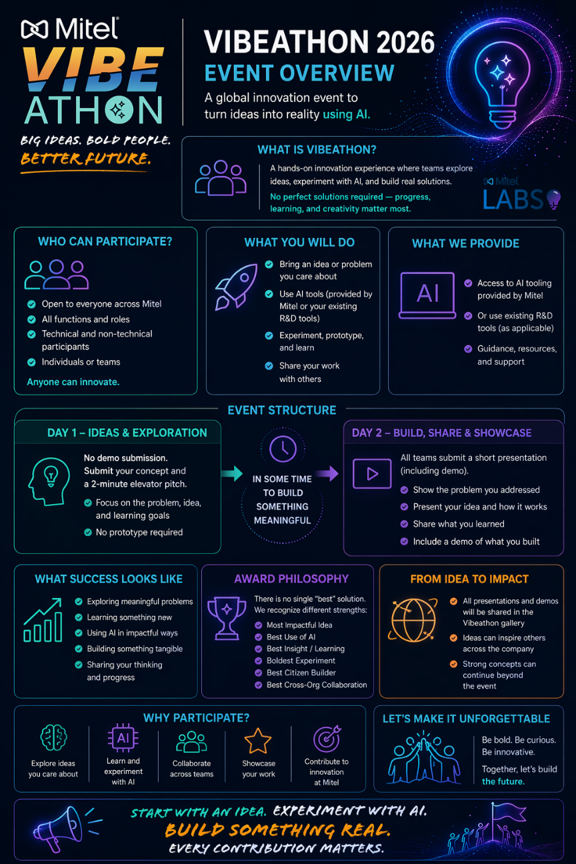
The Vibeathon event brief shared with participants ahead of the sprint.
Two days, across three continents
The event ran in a hybrid format, with participants joining on-site and remotely across EMEA, the Americas, and APAC. Coordinating time zones, submission workflows, and judging panels across that footprint required more behind-the-scenes work than most participants ever saw. The organizing team deliberately kept the participant experience as simple as possible: find a problem, shape an idea, show your work.
On Day 1, teams focused on problem definition and concept. The only deliverable was a two-minute elevator pitch. No prototype required. On Day 2, the work shifted to building. Teams used AI tooling to prototype solutions, refine their thinking, and prepare a short demo. Thirty judges from across the business reviewed submissions against six award categories, ranging from Most Impactful Idea to Best Cross-Org Collaboration.
What happened
The range of ideas was wider than expected. Teams worked on everything from product improvements to internal workflow automation to customer-facing tools. Several projects addressed problems that had been on people's minds for years but had never had a clear path to a prototype.
Including the whole company was a brilliant idea. Great ideas can come from anyone, regardless of their role.
The speed was also striking. Teams moved from problem statement to working demo in less than two days, often with tools they had only started using that week. AI lowered the technical barrier enough that the bottleneck became "what is the right problem to solve" rather than "can we build this?" That is a meaningful shift in what drives innovation.
Post-event, 122 participants completed a feedback survey. The average recommendation score was 8.6 out of 10, with eighty-four percent saying they would participate again. The feedback also pointed to where the next iteration can improve: more preparation time before the sprint, clearer judging criteria communicated upfront, and more structured feedback for teams after the event.
What this connects to
The Vibeathon sits within a broader set of commitments Mitel has made around AI capability building. Alongside events like this one, we are expanding access to AI tooling across the organization, developing guardrails for responsible use, and working to make the skills developed during a sprint like this transferable to everyday work.
Selected ideas from the Vibeathon will move into further evaluation and refinement, with potential to feed into future product and process work. The goal is not to capture every idea that surfaced over two days, but to maintain the momentum and signal clearly that this kind of contribution has a path forward.
Innovation Day gives us a platform to showcase and celebrate innovation. The Vibeathon complements it by creating space for hands-on exploration, learning, and experimentation across the company.
A genuinely energizing two days that proved Mitel has the creative talent and AI ambition to build things that can transform how we work.
What we take forward
The most important thing the Vibeathon demonstrated was not a specific prototype or a winning idea. It was that the creative capacity already exists across this organization, and that the right conditions can surface it quickly.
We will run this again, and we will build on what this first iteration taught us.
To everyone who participated, organized, and judged: thank you.