Connected Care
at Every Bedside
Healthcare organizations face fundamental challenges at the point of care: patients are disconnected from their care experience, and clinical staff are burdened with fragmented systems that hinder workflow efficiency. Health Station HiMed provides a hospital‑grade bedside platform for patient infotainment, secure communication, and direct access to clinical information. It lightens staff workload, improves patient satisfaction, and connects with EHR, nurse call, and clinical workflow systems.
Benefits of Health Station HiMed
Improved Patient Experience & Care Access
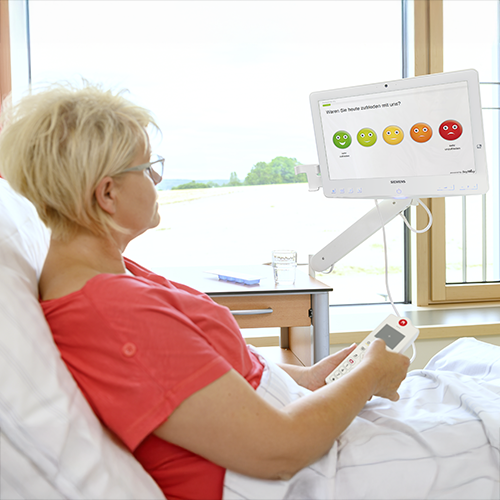
HiMed gives patients practical control over key parts of their hospital stay. They can review information about their treatment plan and daily schedule, request services, order meals, manage entertainment, and contact their care team from the bedside. This level of access reduces uncertainty, supports calmer recovery, and contributes to stronger patient satisfaction scores.
Staff Efficiency & Workflow Optimization
Patient self-service capabilities reduce routine staff requests and interruptions, freeing nursing and medical teams to focus on clinical care. Targeted communication channels ensure patient requests reach the right team at the right time, while digital workflows and virtual task input from patients help staff prioritize effectively, reducing cognitive burden and administrative overhead at the point of care.
Hospital Excellence & Reputation
HiMed drives superior hospital performance by enhancing the patient experience, reducing staff burnout and turnover through workflow automation, and lowering operational costs while protecting existing infrastructure investments via integration with EHR, PACS, LIS, and nurse call systems. This comprehensive approach transforms hospitals into patient-centered digital workplaces that deliver improved care quality and operational excellence
HiMed across the patient journey

For Patient Rooms & Bedside Care
Hospital-grade bedside terminal combining infotainment, care team communication, and clinical workflow access, with antimicrobial surfaces and barrier-free operation for patients with limited mobility.
For Hospital Lobbies & Entry Points
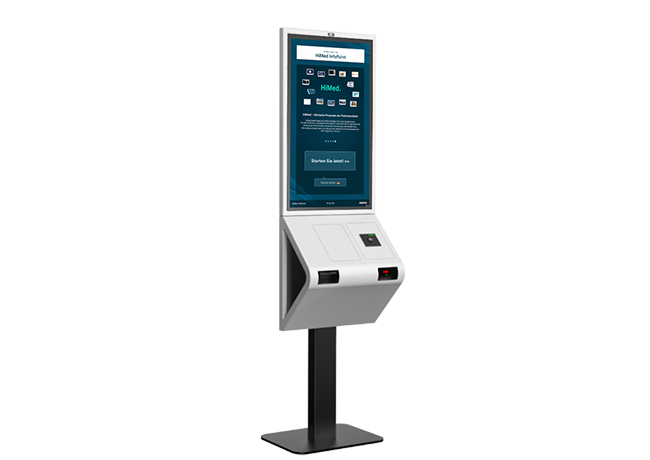
Self-service kiosk enabling patient check-in, payment processing, wayfinding, and hospital information access at entry points throughout the facility.
For End-to-End Hospital Digitalization
HiMed integration capabilities extend beyond basic bedside entertainment, connecting with critical hospital systems such as EMR/EPR, nurse call and IOT systems with escalation paths (OScAR), video consultation services (VCCS), e-Pharmacy, scheduling systems, patient self-service applications, and room controls.
Key Features
Improved Patient Experience & Bedside Control
-
Patients access information about their medical condition, treatment plan, and care schedule directly from the bedside. This helps reduce anxiety and keeps them informed and involved in decisions throughout their hospital stay.
-
HiMed puts patient-to-staff communication at the fingertips of every patient, with targeted channels that route requests to the right team, reducing unnecessary interruptions while improving response times for patient needs.
-
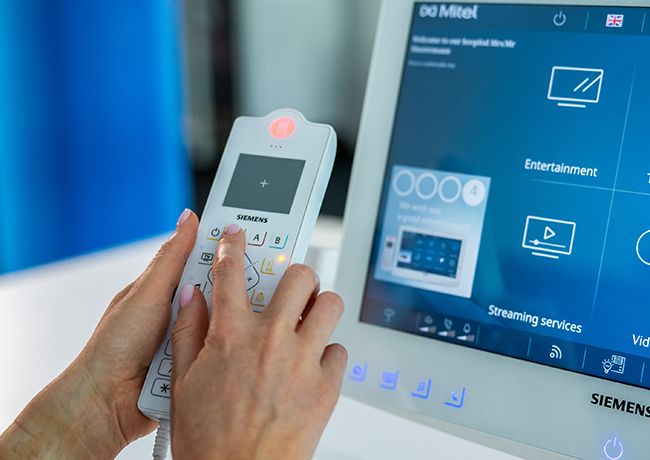
Meal ordering, room controls, on-demand TV, video, newspapers, and magazines, and additional applications give patients full control over their environment, including barrier-free operation designed for patients with limited mobility.
More Efficient Staff and Clinical Workflows
-
HiMed delivers critical patient data directly to frontline clinical staff at the bedside, eliminating time-consuming navigation across fragmented systems and reducing the potential for medical errors through better bedside communication.
-
Integration with existing hospital IT infrastructure—including EMR/EHR, PACS, LIS, CPOE, ePharmacy, and nurse call platforms—ensures that HiMed works within current clinical systems, providing the most convenient way to access and use information without replacing established workflows.
-
Secure patient and staff identification via RFID and QR codes supports accurate documentation, medication verification, and faster care team handoffs, reducing manual entry errors at the point of care.
Integration, Safety & Investment Protection
-
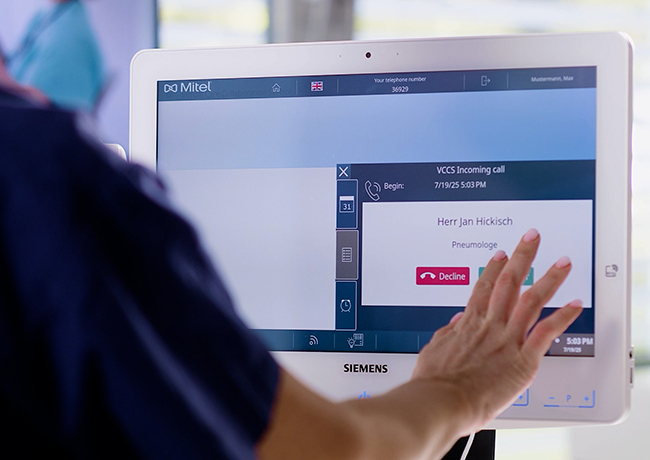
Integration with OpenScape Alarm Response (OScAR) and Virtual Care Collaboration Service (VCCS) extends HiMed into a full safety and virtual care platform to support remote monitoring, alarm workflows, and virtual patient consultations.
-
HiMed's prepaid voucher model creates a direct revenue stream from fee-based patient services — including entertainment, premium content, and additional applications — turning bedside technology into an operational asset.
-
A proven, hospital-grade hardware platform with a documented 7+ year product lifecycle protects capital investment over time, with open standards of integration that connects to existing infrastructure without proprietary lock-in.
- Analyst Report
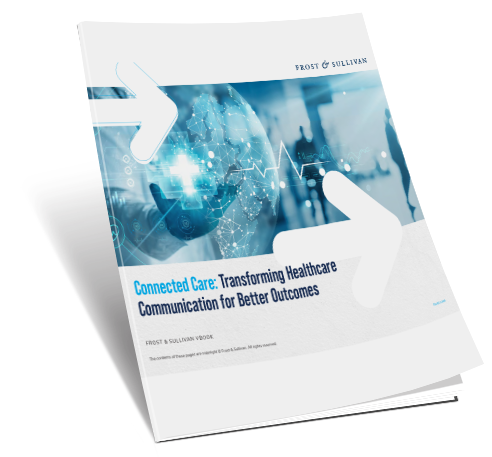
Designing Healthcare Communications for Real-world Complexity
A Frost & Sullivan analyst report exploring how modern healthcare organisations design communications infrastructure to manage clinical complexity — directly validates HiMed's role in patient-side communication.
Awards


Services for Your Healthcare Digital Transformation
Mitel Services help hospitals plan, deploy, and support Health Station HiMed — from integration planning with existing clinical systems to long-term management across the 7+ year product lifespan.
- Consulting: Strategic guidance for digital transformation at the point of care, including workflow analysis and integration planning with existing hospital IT, EMR/EHR, OScAR, VCCS, and UC infrastructure.
- Deployment: Efficient installation and commissioning, with integration to EMR/EHR, nurse call, room automation, and hospital communication platforms across wards and entry points.
- Support: Ongoing software updates, hardware maintenance, and technical support across the 7+ year product lifecycle.

Features Comparison
HiMed includes the Cockpit proX bedside terminal in two display sizes, the MediSET patient infotainment solution, and the InfoPoint self-service kiosk. The table below highlights how features differ across these hardware form factors.
| Features | HiMed Cockpit 14 & 18 proX | HiMed MediSET | HiMed Infopoint |
|---|---|---|---|
| Patient infotainment |  | | |
| Treatment information access | | | |
| Direct care team communication | | | |
| Meal ordering & room control | | | |
| EHR/EMR integration | | ||
| Nurse call integration | | | |
| RFID / QR identification | | RFID only | |
| OScAR integration | | | |
| VCCS integration | | ||
| Secure video communication | | ||
| Disinfectable surface | | | |
| Self-service check-in | | ||
| Integrated POS / voucher payment | | ||
| Wayfinding / navigation | | | |
| Room automation control | | | |
| Open standards integration | | | |
| Telephony integration | | | |
| TV & radio control | | |
Related Products



Frequently Asked Questions - Your Questions About Health Station HiMed Answered
-
HiMed places the patient at the center of care delivery to solve three critical challenges: low patient satisfaction scores that directly impact reimbursement, staff burnout driven by fragmented systems and constant interruptions, and compromised care quality caused by inefficient workflows. By aligning technology and processes around patient needs HiMed reduces friction for both patients and staff—enabling more meaningful interactions, fewer disruptions, and more coordinated care. This helps hospitals retain teams, boost satisfaction, and protect care standards in an increasingly demanding environment. .
-
HiMed is a full point-of-care platform. Beyond patient infotainment and self-service capabilities, it integrates with clinical systems including EMR/EHR, PACS, LIS, nurse call, OScAR, and VCCS. Clinical staff access and document patient data from the bedside, while hospital administrators gain an operational tool for workflow automation, cost reduction, and potential revenue generation through fee-based patient services.
-
HiMed delivers measurable return on investment through improved patient satisfaction scores, reduced staff administrative time, and decreased readmission rates, plus operational cost savings and revenue generation from fee-based patient services. Built on Siemens technology with a 7+ year lifecycle, HiMed protects investment while avoiding the costly 3-4 year replacement cycles of consumer-grade alternatives.
-
HiMed integrates with a broad range of hospital systems through open standards, including EMR/EHR, PACS, LIS, CPOE, ePharmacy, and nurse call platforms. It also connects with OpenScape Alarm Response (OScAR) for safety and alarm workflows, and with the Virtual Care Collaboration Service (VCCS) for remote patient monitoring and virtual consultations, without replacing existing infrastructure.
-
Patient self-service capabilities directly reduce routine staff requests and interruptions, freeing nursing and medical teams for clinical work. Targeted communication channels route patient requests to the right team at the right time. Digital workflows and task prioritization via virtual patient input reduce cognitive burden, addressing the administrative and communication pressures that drive burnout and turnover in understaffed clinical environments.