At this precise moment, the race for effective enterprise-wide AI deployment favors only a few. But it would be an overstatement to say you’re behind the curve if you’re not one of them.
Indeed, the organizations getting AI right are simply being careful. Recognizing the difference between trailing and moving deliberately changes how you plan for what comes next.
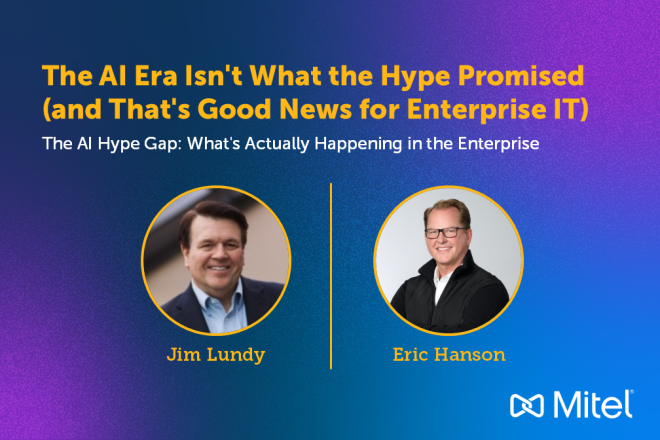
Mitel CMO Eric Hanson sat down with Jim Lundy, Founder, CEO, and Lead Analyst at Aragon Research. What followed was a grounded, sometimes contrarian read of where AI actually stands today.
AI Is Real. Widespread Deployment Isn't. Yet.
For most enterprises, this is still a year of foundation-setting. A useful starting point is to simply make sure the basics are covered. Switching from consumer AI tools to enterprise-licensed versions, for instance, is a step many organizations haven't taken yet, despite the real compliance and data indexing exposure they create.
Beyond the basics, the picture is more uneven. "You cannot [simply] believe what the influencers and hypers are saying," notes Lundy, "because that's just not what's happening." Agentic AI (i.e., systems that take autonomous action across workflows) is still early-stage for most enterprises, with the principal blockers being governance gaps, reliability concerns, and a shortage of vetted implementation support. The organizations that have deployed more advanced AI at scale are typically large enterprises with dedicated resources to test, govern, and iterate.
Lundy's forecast puts the broad productivity impact of AI between 2027 and 2031, which means there's still time to build well. Organizations that focus now on choosing trusted vendors, establishing governance policies, and piloting in controlled environments will be positioned to move fast when the infrastructure matures.
Those that wait may struggle to close the gap. That’s because an important part of building well, it turns out, is rethinking the infrastructure underneath.
Hybrid Is a Strategy, Not a Compromise
For years, hybrid infrastructure felt like a hedge enterprises opted for when they weren't ready to go fully to the cloud. That framing has never been more inaccurate than it is today.
As Lundy puts it: "The SaaS era is winding down." This is being driven by a number of technology realities:
- Proximity: AI processing runs better closer to the data.
- Compliance: Data sovereignty requirements are tightening.
- Economics: Renting compute from hyperscalers is expensive at scale.
- Flexibility: Public cloud lock-in and provider-specific tooling create compounding architectural constraints over time.
The fact is, the cost of running AI workloads in a local data center is dropping. Every major hyperscaler is racing to build edge solutions, precisely because the economics are pointing that way.
For enterprise communications in particular, where latency, uptime, and data residency are non-negotiable, this shift has real architectural implications. It's why Mitel has built its product roadmap around managed private environments combined with selective cloud services: industrial-grade communications demands infrastructure that can be tuned, governed, and secured to organizational specifications.
Communication Security Is Underestimated
That last point — security — is more consequential than most organizations realize.
When was the last time your IT team asked how many network hops a call takes from origination to destination? If the number exceeds three, Lundy flags it as a meaningful risk threshold. More problematically, many organizations are not asking the question at all.
The fundamentals are still not universally applied: device backups, strong authentication, enterprise-licensed tools, and vendors with proper compliance credentials. The attack surface for enterprise communications is larger than most IT teams account for, and it's growing.
For organizations in regulated industries or critical infrastructure roles , the consequences of getting this wrong are severe. A hospital cannot afford to be down. A bank measures acceptable downtime in seconds. For these environments, redundancy is an absolute design requirement. That means understanding your vendors' architecture, their SLA priorities, and whether your communication traffic would be deprioritized in favor of other workloads during peak demand.
This is exactly the type of question that gets answered differently when you're working with a provider that has been through high-availability, high-compliance deployments before.
In fact, getting the infrastructure and security foundations right is what puts the near-term gains within reach.
What the Next Two Years Actually Look Like
Lundy's outlook centers on two things: orchestration and the structured automation of repetitive tasks of the kind that have historically consumed 20–30% of knowledge worker time.
"Most of AI is automation," Lundy said. "It's not intelligence." That reframe matters for procurement, deployment, and expectation-setting. Organizations that evaluate AI tools against a realistic benchmark — can this reliably automate a defined task with acceptable accuracy — will make better buying decisions than those chasing a more expansive vision.
The productivity gains are real, to be clear. They're just more incremental, more selective, and more dependent on implementation quality than the broad-market narrative suggests. For enterprise IT leaders, the clearest near-term wins are agent assist in contact center environments, where the technology is mature and ROI is measurable; low-code workflow automation for clearly scoped repetitive processes; and infrastructure consolidation that positions AI workloads closer to organizational data.
The organizations that will capture the most value from AI over the next few years aren't necessarily the ones moving fastest today. They're the ones building on a foundation of trusted vendors, sound governance, and infrastructure they actually control.
Eric Hanson is Chief Marketing Officer at Mitel. Jim Lundy is Founder, CEO, and Lead Analyst at Aragon Research.
Building a resilient foundation for the next wave of AI starts with your underlying communications infrastructure. Discover how Mitel’s hybrid solutions balance security, control, and innovation, or contact our team today to map your transition.