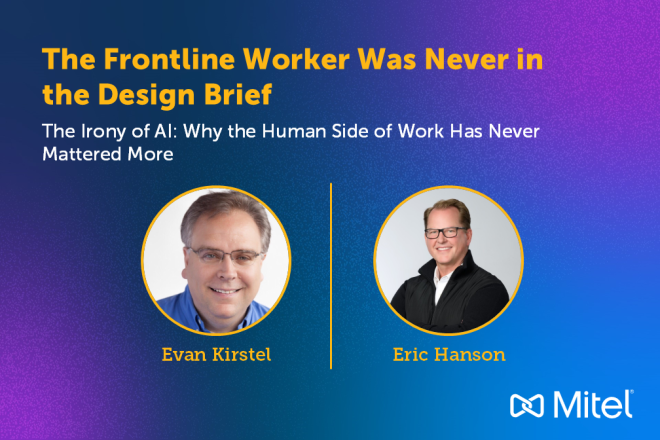
The conversation about AI in the enterprise has been dominated, almost entirely, by knowledge workers. The desk. The laptop. The calendar full of video calls. That's who the tools were built for, and that's who got them first.
Meanwhile, the nurse filling out an EMR with 80 fields, the field technician trying to coordinate in real time, and the retail associate with no reliable way to reach support … they’ve all been waiting.
Tech influencer and analyst Evan Kirstel has spent years talking to organizations across industries, and the pattern he describes is of frontline workers as an afterthought, “not given the latest tools, not trained, equipped, directed, or enabled in ways that they could have and should have."
That's a solution design assumption that went unexamined for too long.
The Irony Created by the AI Era
The fact is, at the precise moment that AI tools are generating the most excitement, the case for human communication is getting stronger, not weaker.
In an age of AI, says Kirstel, "the human-to-human side of communications and personal relationships is as important as ever." The quality of voice, video, and messaging — reliable, persistent, secure — is foundational infrastructure for a workforce that depends on real-time coordination to do its job.
The irony is that the tools most celebrated right now were largely built to automate interactions, not to support the workers having them. According to Kirstel, a lot of what's coming out of Silicon Valley is "designed at replacing frontline workers, not necessarily enabling them, empowering them, or giving them tools to help customers."
But the organizations extracting the most value from AI right now are the ones going far beyond simply investigating what AI can replace, to asking “what can AI take off the plate of people we can't afford to lose?”
Drudgery Is a Retention Problem (and Deployment Is Not the Answer)
Healthcare is the clearest example, but the dynamic runs across industries. Doctors and nurses aren't worried about AI taking their jobs. Any job movement will more likely revolve around them quitting instead. The paperwork, the outdated systems, the pagers and fax machines still in active use: these are the primary drivers of burnout in a profession that already can't hire fast enough.
In Kirstel's perspective, the goal is to "take the drudgery out of the job so they can focus on patients, on themselves, on their own training." In other words, the case for AI is now a workforce sustainability argument.
When you understand AI's role in the context of automating form completion, surfacing relevant information, and removing the friction between a worker and the task that actually matters, the ROI question becomes much more concrete. It’s less about productivity and percentages, and more about whether the people you depend on stay.
But that outcome doesn't follow automatically from deployment. There's a version of AI adoption that amounts to handing workers a new app and calling it a transformation. Kirstel is skeptical: the organizations getting results are the ones focused on "really training and equipping workers on a few best-of-breed tools," rather than handing over whatever happens to be available and moving on.
The difference between a tool deployed and a tool used is training, context, and fit. According to Kirstel, a “realistic” productivity boost of 10–20% comes from workers who understand what a tool is for and how it makes a specific part of their job easier.
That requires staying invested in adoption well past go-live, and it requires choosing tools designed for the role in the first place.
The Infrastructure under the Ambition
None of this is achievable if the communications infrastructure hasn't kept pace. And in many organizations, it just hasn't.
Kirstel describes systems "in closets from the 60s or 70s" that have persisted because, as the old joke goes, so long as the phones don't quit, everything is fine. But that tolerance for aging infrastructure carries consequences: ransomware vulnerability, no redundancy, no hybrid working options, limited disaster recovery when a storm or a security incident takes a network down.
The playbook he calls for is one that is "hybrid, secure, and modern," built not just for the communications needs of today, but for the resilience requirements that keep surfacing as organizations learn what happens when those needs aren't met.
For frontline-heavy industries like healthcare, field services, and manufacturing, that’s what makes the difference between a workforce that can function under pressure and one that can't.
The frontline worker wasn't in the original design brief for a lot of enterprise communications platforms. But that gap is now addressable, if the organizations filling it are deliberate about who they're designing for. If your communications infrastructure was built for knowledge workers and adapted for everyone else, it may be worth re-examining now.
A Mitel specialist can help you map a communications architecture designed for the full range of your workforce. Let's talk.
- AI,
- ,
- Guest Insights