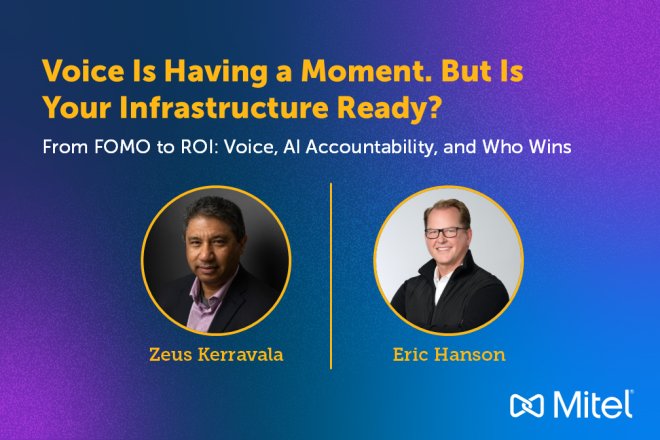
When it comes to today’s vendor landscape, tech analyst Zeus Kerravala is unequivocal: "There's going to be a premium put on the ability to deliver highly reliable, secure voice,” he says. “And that's not a skill set you can just create a startup today to replicate."
This observation is the natural extension of a shift that's been building for years, to the point where it’s now impossible to ignore. AI has finally made voice interfaces work: multi-language, varied accents, and natural conversation no longer trip it up. And as a result, every enterprise workflow is being rebuilt around voice as a primary input.
But what’s important to recognize is that the infrastructure underneath that shift matters more than most vendors want to admit.
The Critical Gap in the Cloud-First Narrative
For the better part of a decade, the prevailing wisdom from the communications industry was fairly simple: move everything to the cloud, consolidate, simplify. It was a reasonable argument, for a specific set of conditions.
Those conditions are changing. Digital sovereignty requirements are expanding across Europe. Regulated industries in the US are tightening data governance expectations. Enterprises with global footprints are discovering that a single public cloud architecture can't satisfy compliance in every jurisdiction without significant cost and complexity.
Kerravala notes that even the largest cloud pure-plays are now scrambling to build sovereign cloud instances country by country — an expensive proposition that only the biggest players can sustain (and even then, incompletely).
Private cloud, meanwhile, has been the reality for critical enterprise workloads outside of communications for years, with communications simply lagging behind. That lag is now closing, because it has to.
Hybrid: A Deliberate Architecture
The framing that articulates hybrid communications as "the best of both worlds" undersells its true value: it’s a deliberate architectural decision to place workloads where they perform best, comply most cleanly, and cost the least to operate.
For some organizations, that means keeping voice infrastructure where it’s closer to the employees, the data, and the compliance boundary: on-premises or in a private cloud. For others, it means a carefully segmented mix of cloud and on-prem depending on geography or business unit. The point is that the decision should be driven by operational requirements, not by what a vendor's product catalog can support.
AI at the Edge Is Reshaping What "Proximity" Means
Kerravala returned from the 2026 edition of Mobile World Congress having taken note of a clear signal: silicon manufacturers such as AMD, Intel, and Nvidia are directing major investment toward edge inferencing. The implication is that with the data center AI build-out maturing, the next wave of economic value is at the edge, where data, compute, and users meet.
For communications, this has direct ramifications. Real-time voice and collaboration demand low latency. AI-assisted features such as transcription, translation, summarization, and agent support perform better when the inference happens close to where the conversation is occurring.
Small language models, fine-tuned for specific industries or company contexts, are more practical to deploy and govern at the edge than large general-purpose models running in centralized data centers.
This is where communications infrastructure and AI strategy converge. Organizations that have maintained precision control over their communications environment, whether on-premises, private cloud, or hybrid, are better positioned to deploy AI at the point of interaction, with the governance controls their compliance teams require.
The ROI Question Can No Longer Be Deferred
Early AI adoption was driven, in no small part, by competitive anxiety. Boards and executives worried about being left behind while competitors moved faster.
That phase is ending. The question boards are now asking is not so much "are we doing AI?" as "what did we get for it?" In other words, they’re less interested in technology demonstrations than in documented outcomes. Conversations center on accountability, not possibility. And while the experimentation phase produced a lot of learning, now organizations need results.
In communications, this translates to the requirement for a clear set of metrics: Are AI-assisted tools reducing handle time in contact centers? Is voice transcription and summarization actually being used and saving time? Are AI features improving first-contact resolution, or just adding interface complexity?
This is why the next phase of enterprise voice requires practical application over hype. Mitel's approach to AI in communications is built around these measurable use cases, like automated summarization, real-time assistance, workflow automation. In other words: proof, not promise.
Voice as Interface: What the Renaissance Actually Requires
There's a temptation to treat a renewed emphasis on voice as primarily a consumer story (think smart speakers, voice assistants, hands-free search …). But the enterprise implications are at least as significant.
If voice becomes the primary interface for applications, then the reliability, security, and quality of voice infrastructure become a foundational business requirement. A dropped call during a customer escalation, a degraded audio experience on a critical negotiation, or a voice AI that misroutes because of latency all represent operational failures.
The organizations that get the most value from voice as an interface are the ones that have invested in voice infrastructure as a strategic asset. That means redundancy, quality of service controls, security architecture, and the ability to integrate voice with the workflows where decisions actually happen.
Kerravala's broader point applies here too. The premium that’s being placed on reliable, secure voice doesn't wait for organizations to get ready, and you can't simply switch on infrastructure discipline after years of treating voice as a commodity. The window for deliberate preparation is now.
The cloud-first narrative has a gap. Whether you're filling it with private cloud, on-prem, or a deliberate hybrid, Mitel can help you build an architecture that actually fits. Let's map it out together.