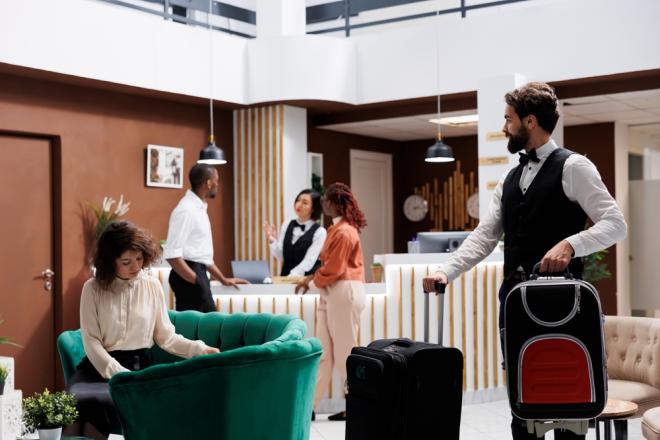
Every understaffed property runs on workarounds. A housekeeping team coordinates through a WhatsApp group the property can't see, because the official app is slower than a text. An engineer three decks down radios the front desk to confirm a work order that's already sitting, unread, in a second system. A duty manager rebuilds the open-request list at shift change because three platforms each hold a piece of it.
These workarounds may be resourceful solutions to point problems, but in the aggregate they function like a tax that's paid daily, in minutes and missed requests, by the people a property can least afford to lose.
And in hospitality, losing them is the norm: the industry churns through staff at rates most sectors would treat as a crisis. Frost & Sullivan finds that high staff turnover, labour shortages, and rising operational costs pose direct risks to both efficiency and guest experience.
Turnover is an outflow problem, and the “normal” instinct to recruit harder, onboard faster, and backfill sooner simply pours more water into a leaking bucket. The leak itself is caused by daily friction in the communication systems staff use to coordinate every task and every shift, and that’s precisely the kind of friction that convinces good people to leave.
Where the Minutes (and the People) Go
Communications and collaboration infrastructure determines how much service a team of a given size can actually deliver, and how it feels to deliver it. When that infrastructure fragments, three failure patterns emerge. Each one converts scarce labour into wasted motion, and wasted motion into resignations.
1. Tool overload.
Staff juggle a booking screen, a housekeeping app, a radio, a desk phone, and a group chat to complete tasks that are, operationally, one workflow. Frost & Sullivan reports that 66% of hospitality organizations cite the burden of too many communication tools as a driver of communication breakdowns. Every additional platform adds a context switch, a login, a place for a request to stall. For a veteran, this is friction. For a new hire, it's a wall: every extra system extends ramp-up time, and in a high-churn property, a meaningful share of the workforce is always ramping. Cruise lines and seasonal resorts live at the extreme of this: crews turn over by contract cycle and staff by season, so entire teams can be new at once.
2. Role-inappropriate tools.
A housekeeper pushing a cart, a server carrying plates, and a maintenance tech on a ladder all work with their hands occupied and away from a desk. Tools designed for office workers fail them by design. In the same study, 63% of organizations cite the lack of appropriate tools for specific employee roles. This manifests downstream, where roughly 7 in 10 organizations report workflow inefficiencies in housekeeping and room service. Frontline staff experience these tools as a daily message about how much their work was considered when the systems were bought—and they act on that message.
3. Shadow workarounds.
When official systems fail frontline reality, personal phones fill the gap. A WhatsApp group forms. Requests move through channels the property can neither see nor measure. This is where turnover bites hardest, in shadow systems that live in people's heads and personal devices. The veteran who knows which group chat reaches engineering after 10 p.m., which extension the night auditor answers, which requests need a follow-up nudge — she walks out the door with all of it. Every departure erases a piece of the property's real and invisible operating manual.
The Turnover Flywheel
These patterns feed a cycle that revolves on its own momentum. Fragmented tools create friction. Friction accelerates burnout (Frost & Sullivan draws the line directly: when front-desk systems and housekeeping apps operate in isolation, guest requests vanish, service lags, and staff burnout increases). Burnout drives departures.
Departures take institutional knowledge with them, which makes the fragmented systems even harder to navigate for whoever remains, and for whoever arrives next. Service quality dips, complaints rise, and the job gets worse, which drives the next departure.
Recruitment spend fights the last step of that cycle. Communications infrastructure intervenes at the first.
Earlier intervention is the better use of scarce budget. Replacing an employee costs a meaningful multiple of their monthly wage once recruiting, training, and lost productivity are counted, and every replacement resets the ramp-up clock on tools that were hard to learn the first time. A retention budget that fixes the friction driving departures will buy down all of those costs at once, whereas a recruitment budget pays them again with every hire.
Building a Property Staff Stick With
People stay in jobs that work smoothly day to day, and in hospitality, how smoothly the day runs is substantially a communications question.
Frost & Sullivan identifies rising labour costs and shortages as one of three core pillars of hospitality modernization, noting that AI-driven task routing and labour management insights allow providers to maintain service levels with leaner staffing models, reduce employee burnout, and increase retention.
In practice, this means:
- Consolidate the toolset around the workflow. Map how a guest request actually travels, from intake to assignment to completion, and reduce the number of systems it crosses. Every eliminated handoff returns minutes to the floor and days to onboarding.
- Fit the tool to the role. Frontline teams need communication that works hands-busy, on the move, and mid-task. Tools that respect how the work is done tell staff their roles were taken seriously, and that message compounds into retention.
- Automate the routine coordination. Task routing, status updates, and event notifications are clerical work currently performed by humans. Frost & Sullivan finds 62% of organizations cite the lack of automated event notifications as a breakdown driver. Automation frees staff for the guest-facing work most of them signed up to do.
- Get the operating manual out of people's heads. When requests flow through governed channels, the knowledge of how things get done belongs to the property. Staff will still leave, but the process knowledge no longer leaves with them.
Counting the Tax
Out-recruiting your turnover assumes an endless supply of replacements. The current team is a better place to invest: a meaningful share of their working hours is lost to coordination friction the right infrastructure would absorb.
Ask your longest-tenured frontline employee to list the unofficial workarounds she'd need to teach her replacement. The length of that list is your workaround tax rate, and a preview of exactly what you'll lose the day she resigns.
Every property pays this tax. The choice is whether to keep paying it invisibly, or to treat reducing it as a retention strategy that’s intentionally measured and funded.
How Mitel Can Help
Mitel builds communications for properties where most of the workforce is on its feet — hotels, resorts, and cruise ships alike. The capabilities below map directly onto the four principles above, and because they're deployed together as one platform, a guest request travels a single governed path from intake to completion.
Application | Description | Product |
One toolset for the whole workflow | Calling, messaging, presence, and coordination in a single platform, replacing the patchwork of apps, radios, and group chats that fragments a shift. | MiVoice Business with MiCollab |
Fixed positions, dependable phones | Desk phones for the front desk, back office, and guest rooms and cabins — hospitality-ready features, familiar to every new hire on day one, and built to run for years. | |
Communication built for hands-busy roles | Rugged DECT handsets with full-shift battery and property-wide coverage across buildings, grounds, and decks — and the H60 AI DECT headset with hands-free voice commands for staff whose hands are on carts, trays, and tools. | |
Routine requests handled, and measured | AI-assisted handling of high-volume, repeatable guest requests takes the towel calls off the front desk — while queue and channel analytics show managers the real demand behind the staffing plan. | Mitel CX with AI Receptionist Agent |
Automated task routing and notifications | Role-aware, AI-enabled workflows that route requests, push status updates, and trigger notifications — getting the right information to the right staff member at the right moment, adjustable by the property itself. | |
Communications run without adding headcount | Monitoring, management, and optimization of the communications environment delivered as a service, keeping the property's staffing constraints away from the phone system itself. |
Ready to see what this looks like on your property? Talk to Mitel or a certified Mitel partner about a workflow assessment: [Contact sales →]