Communications built around your worst day, not your average day
Communication failures cause over 70% of sentinel events in healthcare. Mitel eliminates the fragmentation, lag, and downtime that put patients at risk, with infrastructure that holds under pressure, workflows that accelerate the impact of clinical teams, and patient access that works the way patients expect.

multi-site and global


compliance details →
Three pressures are converging. Most hospitals are managing all of them at once.
Clinical staff are overwhelmed, legacy systems are carrying more and more risk, and patient access expectations have outpaced what most hospitals can currently offer. That's the operating reality for healthcare IT and operations leaders today.
of healthcare IT leaders say their clinical staff are burdened by too many communication tools. The problem is not access to technology, but too much of the wrong kind.
are prioritising emergency and critical care workflows, where communication failure has the most direct consequences for patients and staff.
cite scalability and reliability as their top infrastructure concerns, meaning the systems running today may not hold up under tomorrow's demand.
Communication that works wherever care is happening.
Mitel solutions are built around the outcomes that matter most to healthcare leaders: systems that never go down, patients who can actually get in, and a workforce that doesn't burn out in the process.
Always-on clinical communications.
Outages, surges, cyber incidents: these are the moments when clinical communications matter most. Mitel keeps them active through all of them.
- Life-safety alerts that don't depend on the cloudEmergency escalations and critical notifications stay active even when cloud connectivity drops.
- Staff safety tools with real-time location trackingProtect staff without escalating patient situations.
- Command-and-control oversightEvery emergency gets a coordinated, auditable response.
There is no acceptable downtime. This is patient safety infrastructure, designed for the moments when it cannot fail.

 Critical Comms
Communications that work the way clinical teams do.
Clinical staff shouldn't have to stop caring for patients to communicate about them. Mitel connects communication to EHR and clinical workflows so the information care teams need arrives before they have to search for it.
- Instant patient context on every callSaves 43 seconds per interaction.
- Automated reminders, refills, and billing queriesFree clinical staff for complex patient needs.
- AI patient trackingEliminates manual location searches at every handoff.
When communication is embedded in the clinical workflow, staff spend less time on the system and more time on the patient.

 Care Workflows
The first failure in patient care is often a call for help that didn't connect.
Patients who can reach you easily are patients who trust you. Mitel ensures every interaction works the way patients expect it to, from first call to follow-up.
- Conversational AI for scheduling and confirmationHandles authentication and appointment confirmation with no hold queue.
- 24/7 automated reminders, refills, and billingNo clinical staff involvement required.
- EHR-triggered outreachCuts no-shows and recovers clinical capacity.
Patient access affects throughput, outcomes, and the metrics every healthcare organisation is held to.

 Patient Empowerment
The capabilities behind every clinical communication, from the ward to the waiting room.
The right tool depends on the challenge you're looking to solve. These are the Mitel products most commonly deployed in hospital environments.

Health Station HiMed
A single touchpoint for clinical workflows and patient communication.
Virtual Care Collaboration Service
Zero-download virtual care that integrates with your EMR.
Openscape Alarm Response
Automated alerting that mobilises the right people instantly.
Mitel CX
Patients reach the right person first time, every channel.
Business Platforms
Resilient voice across every site: on-premises, cloud, or hybrid.
Mitel Workflow Studio
Low-code workflows that automate routine tasks, freeing staff for patients.
- Healthcare
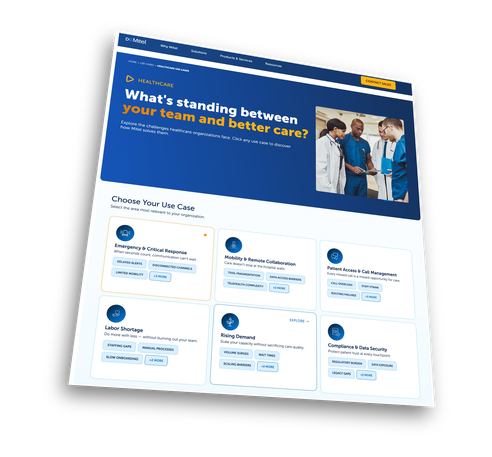
Healthcare Use Case Explorer
Explore the challenges healthcare organizations face, and how Mitel solves them.
Meet some of the healthcare organisations running on Mitel.
Building Trust and Reliability in Healthcare Communications
The 2025 Frost & Sullivan report on healthcare communications transformation, covering market direction and provider analysis.
Get the report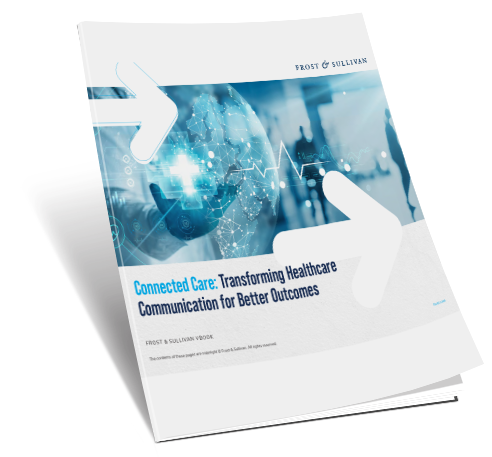
The Complexity Crisis in Healthcare Communications
How fragmented tools and aging infrastructure are adding clinical and operational load — and what high-performing systems are doing differently.
Read the analysis →
With Healthcare Demand Rising, Communication Architecture Decides Who Can Keep Up
HRising patient demand is exposing the limits of legacy communication systems. Discover how unified, scalable platforms help healthcare organizations stabilize operations and improve patient access.
Learn more →
Aragon Globe for Hybrid Communications
Independent analyst review of hybrid communications providers, including Mitel positioning and customer references.
Get the report →Your healthcare communication questions, answered.
What healthcare challenges does Mitel address?
How does Mitel improve patient experience?
What is Virtual Care Collaboration Service (VCCS)?
Can Mitel support on-site, private cloud, and hybrid deployments?
How does Mitel help reduce no-shows and improve throughput?
What integrations are available for clinical workflows?
What's the impact on staff productivity and burnout?
Can Mitel scale to large health systems?
Get in touch with our healthcare team.
Share a few details about your organisation and we'll connect you with a Mitel specialist familiar with healthcare deployments and compliance requirements.
- Architecture review of your current voice and mobility deployment
- Reference customers in your size band, on request
- Response within 1 business day
Fill out the form and we'll get back to you shortly
By submitting, you agree to our privacy policy. We will use your details only to respond to this enquiry.