UC Platform That
Doesn't ForceCloud Migration Timelines
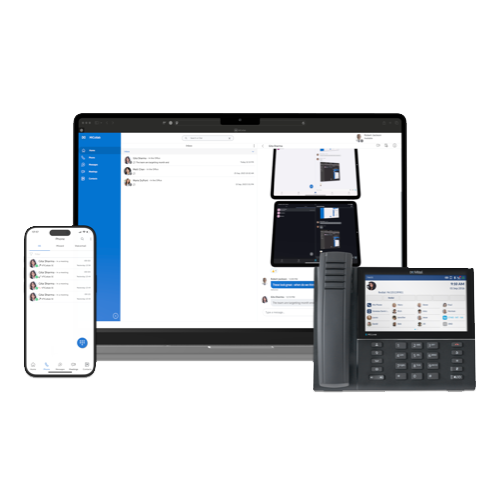
Cloud-only vendors eliminate deployment choice to maximize recurring revenue regardless of your actual requirements. MiVoice Business provides complete unified communications with genuine deployment flexibility—on-premises for data sovereignty, private cloud for infrastructure modernization, public cloud (AWS, Azure) for specific workloads, or hybrid architecture matching your actual business constraints. Scaling from 5 to 65,000 users on a single platform, MiVoice Business delivers the choice and deployment flexibility demanded by today’s UC customer. The entire solution is available with traditional CapEx perpetual license purchase or the OpEx subscription payment model.

Benefits of MiVoice Business
Deploy Based on Business Requirements, Not Vendor Revenue Models
Choose on-premises, private cloud, public cloud (AWS, Azure), or hybrid deployment – the only major UC platform provider that doesn't eliminate deployment options to force subscription revenue. Protect existing hardware investments while enabling gradual cloud migration on your timeline, moving workloads when compliance requirements evolve rather than when vendor end-of-support deadlines force expensive infrastructure replacement.
Enterprise Features Without Artificial Scale Limits
Large, small or in between, MiVoice Business Unified communications capabilities scale from 5 to 65,000 users on single platform architecture with feature parity across all deployment models. Change deployment mix as business evolves – headquarters on-premises, acquired companies in cloud, branch offices hybrid – without replacing platform or paying migration professional services.
Vertical Integrations That Actually Work Out of the Box
Purpose-built integrations for healthcare (nurse call systems, patient communication), hospitality (property management systems, reservation platforms), financial services (compliance recording, trading floor), government (data sovereignty, emergency services), and education (campus-wide communication, classroom integration) deliver industry-specific functionality without custom development projects to make generic platform work for actual business processes.
Deployment Options

For On-Premises and Hybrid Organizations
Complete infrastructure control using Mitel controllers or industry-standard servers.
MiVoice Business On-Premises | MiVB Small Business | MiVB EX Controller | Industry Standard Server
For Private Cloud Deployments
Dedicated private cloud infrastructure, enterprise control and custom compliance configurations with VMware, Hyper-V, Nutanix and Proxmox virtualization platform support.
MiVoice Business Private Cloud deployment within own data center
For Public Cloud Transformation
Native AWS and Azure deployment for incremental cloud adoption without forced migration.
MiVoice Business on AWS | MiVoice Business on Azure
Key Features

Deployment Flexibility That Protects Infrastructure Investments
-
Only major UC vendor offering genuine choice between on-premises, private cloud, and public cloud deployment without forcing single model to simplify vendor operations. Same platform codebase across all deployment options enables seamless workload migration based on compliance requirements, cost optimization or merger integration.
-
Native support for AWS and Azure for public cloud environments plus on-premises and private cloud deployments prevents vendorl ock-in to a single cloud provider. Deploy MiVoice Business matching your broader cloud strategy with the flexibility to purchase via traditional CapEx perpetual license or the OpEx subscription payment model.
-
Local calling survivability maintains voice service during WAN outages or data center incidents with automatic resynchronization when connectivity restores. Branch office communications remain operational during network failures without requiring duplicate infrastructure at every location – critical for organizations with dozens of branch offices where full redundancy hardware doesn't make economic sense.

Enterprise UC Without Platform Limitations
-
Superior collaboration and contact center solutions with intelligent routing offer PBX features, advanced call control, mobility, and IP desk phone options to enable customers to choose where and how they communicate.
-
Real-time presence across desk phones, mobile devices, and desktop applications including Microsoft Teams and Zoom Workplace. Presence integration extends to calendar systems for automatic status updates based on scheduled meetings – reducing the manual status management that makes presence features theoretical rather than practical in most UC deployments.
-
Whether in the office, at home, or on the road, MiVoice Business brings people together to offer feature-rich telephony and collaboration and real-time communications. Organizations can choose chat, video conferencing, screen sharing, file sharing, and more, all in one solution.
Scale and Administration That Matches Enterprise Reality
-
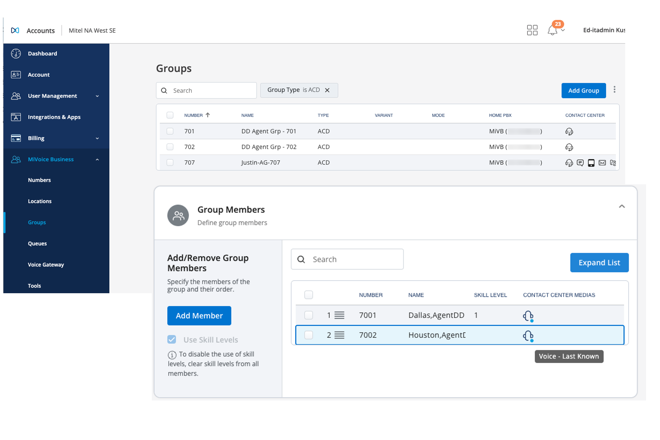
Scale from 5 to 65,000 users on unified platform architecture with centralized administration across all locations. Unlike platforms requiring federation or separate instances above arbitrary user counts, MiVoice Business maintains a unified dial plan, directory, and management at enterprise scale without architectural compromises that create operational complexity.
-
The Web-based administration interface simplifies user provisioning, moves/adds/changes, and configuration management provided by MiVoice Business administration portal, without requiring dedicated telephony administrators for routine operations. Self-service portals enable distributed administration by local IT teams or department managers while maintaining centralized policy control and compliance oversight.
-
Mitel CX integrates natively with MiVoice Business to deliver omnichannel customer engagement without relying on third-party platforms or complex integration projects. This unified approach reduces operational complexity and ensures consistent functionality across voice and contact center environments.
- White Paper
A Funny Thing Happened On The Way To UCaaS
Discover AI-powered, secure, and durable communication tools for frontline workers and learn how Mitel empowers deskless employees across industries.
Discover why the path to cloud communications isn't always straightforward—and how
hybrid UC deployment gives enterprises the flexibility to modernize at their own pace without forced
migration or vendor lock-in.
MiVoice Business in Action

The Van Mossel Groep
The Van Mossel Groep (VMG) is the premier automotive company in the Benelux region with over 70 years in the industry, more than 4,600 employees, and 300 branches. VMG owns various dealerships representing nearly all major car brands and has many damage repair and leasing companies under its purview.

Heilig Hart Hospital
Heilig Hart Hospital is a general hospital in Mol, Belgium, with 183 accredited beds, a large day hospital, and extensive consultation services. With around 10,000 inpatients and over 23,000 hospital patients per day every year, Heilig Hart’s approximate 750 employees, 100 doctors, and 30 volunteers work to provide patients with both basic services and highly specialized medicine. The hospital also collaborates with regional partners, including primary care providers, nursing homes, and university centers, and is a part of the Kempen Hospital Network.

Lenkerhof Hotel and Gourmet Spa Resort
The five-star Lenkerhof Hotel and Gourmet Spa Resort in Simmental, Switzerland offers its discerning guests excellent service and personal care to the tiniest detail. To achieve that distinction, employees of one of Switzerland’s most established luxury hotels must be able to rely on a top-class telecommunications system operating around the clock.
The Van Mossel Groep
The Van Mossel Groep (VMG) is the premier automotive company in the Benelux region with over 70 years in the industry, more than 4,600 employees, and 300 branches. VMG owns various dealerships representing nearly all major car brands and has many damage repair and leasing companies under its purview.
Awards


Services for your UC Platform
Mitel Services support planning, deployment, and ongoing optimization of MiVoice Business to meet operational requirements and business objectives
- Consulting : Strategic guidance for mobility and safety requirements
- Deployment : Efficient setup and integration with the communication ecosystem
- Support : Ongoing updates and optimization for reliable performance

Deployment Comparison
| Features | On-Premise | Private Cloud | Public Cloud | Hybrid |
|---|---|---|---|---|
| Data Control | Complete | Complete | Shared | Mixed |
| CapEx | High | Medium | Low | Mixed |
| OpEx | Low | Medium | High | Mixed |
| Deployment Speed | Weeks | Days | Hours | Mixed |
| Scalability | Manual | Flexible | Automatic | Flexible |
| Compliance Control | Maximum | High | Medium | High |
Related Products




MiVoice Business Frequently Asked Questions
-
MiVoice Business is a complete communications and collaboration solution that combines telephony, messaging, video conferencing, mobility, and contact center tools into one unified platform — available on-premises, in the cloud, or as a hybrid.
-
It’s ideal for businesses of all sizes — from small and midsized offices to global enterprises — that need flexible, secure, and scalable communication tools.
-
MiVoice Business comes with MiCollab, which offers chat, video conferencing, screen sharing, file sharing, presence, and team workspaces — all accessible from desktop or mobile.
-
Features like Single Number Reach, Hot Desking, and Teleworker mode let employees work from anywhere while keeping the same business phone experience.
-
Yes. MiVoice Business supports 5 to 65,000 users, making it flexible enough to grow with your organization without needing a platform change.
-
Cloud-only vendors eliminate on-premises options because subscription revenue is more predictable than perpetual licensing regardless of whether cloud deployment matches your actual requirements. Organizations with data sovereignty mandates, compliance restrictions on cloud providers, massive existing infrastructure investments, or merger integrations with incompatible platforms need deployment flexibility to avoid expensive forklift upgrades driven by vendor business models rather than technical requirements. Hybrid deployment enables gradual modernization on your timeline rather than vendor-imposed end-of-support deadlines.
-
codebase across on-premises, private cloud, and public cloud deployments enables workload migration without replacing infrastructure or retraining users. However, migration requires network planning, security architecture updates, and potentially professional services depending on deployment complexity—this isn't magic button migration but structured transition matching your change management capabilities and compliance approval processes. Migration flexibility protects against vendor lock-in while acknowledging that actual migrations require planning regardless of platform portability.
-
Purpose-built integrations ship with the platform rather than requiring custom development projects, third-party middleware, or professional services engagement to connect UC platform to industry-specific applications. Healthcare nurse call integration, hospitality property management system connectivity, financial services compliance recording, and government emergency services integration work out of the box because these industries represent significant vertical markets rather than edge cases requiring one-off custom development. Generic horizontal platforms force every industry-specific requirement into expensive custom integration.
-
CapEx model (perpetual licensing with annual maintenance) suits organizations with capital budget flexibility and preference for asset ownership, while OpEx model (monthly subscription) fits operational expense preference and gradual adoption patterns. However, total cost of ownership over platform lifecycle depends on user count, feature tier, deployment model, and replacement cycle timing—run actual TCO analysis for your specific deployment rather than assuming one licensing model universally costs less. Licensing flexibility enables financial planning matching your capital structure and budgeting processes.
-
Yes. MiVoice Business integrates directly with the Zoom Workplace App, letting you bridge Mitel’s advanced telephony with Zoom’s collaboration environment.
-
Mitel Workflow Studio is an integration platform that lets you easily create, manage, and automate communication workflows, and integrate them into business processes. It facilitates new and existing integrations of Mitel solutions with third-party applications. Workflow Studio reinforces Mitel’s AI readiness by integrating with major GenAI providers, enabling smarter business processes.