Carrier-Grade Voice Infrastructure
at Enterprise Scale
Moving tens of thousands of numbers across carriers and regions is a multi-year, compliance-heavy transition. Most cloud-only UCaaS platforms can’t handle that complexity. OpenScape Voice is built for scale and certainty. It delivers carrier-grade reliability with active-active architecture, five-nines availability, and support for up to 100,000 users on a single platform. Choose on-premises, private cloud, or hybrid deployment to migrate at your pace, without forced rip-and-replace or service disruption. For enterprises and service providers that need telecom-grade resilience, OpenScape Voice keeps critical communications running when standard UC platforms fall short.

Benefits of OpenScape Voice
Eliminate Revenue Loss from Communication Downtime
Five-nines availability means near-continuous uptime, with downtime measured in minutes per year, not hours. With active-active architecture, calls stay connected even during hardware failures thanks to automatic failover. This level of resilience prevents costly outages in environments where every minute matters, including financial trading floors, contact centers, and healthcare facilities. When downtime threatens revenue, compliance, or patient safety, OpenScape Voice ensures your communications stay operational.
Scale Without Platform Fragmentation or Management Multiplication
Single platform supports up to 100,000 users with virtually unlimited capacity when networked across data centers. Service providers eliminate the need for 10-20 separate UC platforms by consolidating customers onto unified infrastructure, reducing management overhead while maintaining consistent feature sets. Large enterprises deploy global voice infrastructure without the regional platform fragmentation that creates incompatible features, integration nightmares, and multiplied administrative workload across IT teams managing different systems in each geography.
Protect Infrastructure Investments During Modernization
Hybrid deployment gives you flexibility to modernize without disruption. Instead of costly forklift replacements, you can transition from legacy systems to IP-based architecture at your own pace. Existing hardware remains in service while cloud capabilities are added incrementally. SIP-based design ensures compatibility with third-party devices—avoiding the forced endpoint replacements common with proprietary platforms. And with subscription-based licensing, you shift from heavy upfront capital costs to predictable operational expenses that scale with your business.
OpenScape Voice Deployment Models for Enterprise Scale

For On-Premise Control and Data Sovereignty
Deploy voice infrastructure within corporate data centers to maintain complete control over data residency and security policies.
On-Premise Deployment: Virtualized architecture based on hypervisor support, carrier-grade availability, perpetual or subscription licensing
For Service Provider Hosted Voice Services
Multi-tenant platform enabling managed service providers to deliver hosted voice services to business customers.
Private Cloud/Hosted: Multi-tenancy support, subscription licensing, billing integration, service provider management tools
For Hybrid Gradual Migration Strategies
Combine on-premises legacy infrastructure with cloud components—supporting hybrid support, phased transitions and geographic distribution.
Hybrid Deployment: Networked systems, Mitel SBC survivability, geographic redundancy, seamless user experience
Key Features

Enterprise Voice Infrastructure
-
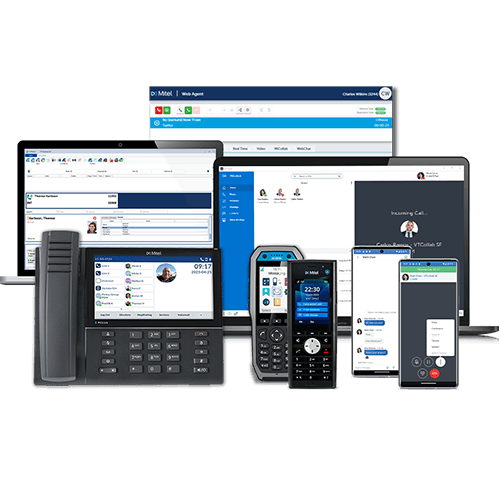
100 percent SIP-based enterprise VoIP solution enables standards-compliant device integration. The platform supports Mitel IP phones, third-party SIP endpoints, softphones, and mobile clients through open-standard Session Initiation Protocol. Embedded media server provides video capabilities. Advanced routing enables complex call distribution across geographically distributed infrastructure for multi-site global deployments.
-
Program frequently used functions like call transfers, conference setups, or directory access to individual buttons, eliminating multi-step menu navigation and reducing average handle time for high-volume call environments like reception desks or support centers.
-
Carrier-grade reliability through active-active server configuration with automatic failover maintains five-nines (99.999%) availability. The system distributes active calls across redundant servers. Full call failover support ensures zero call loss on single node failure through real-time call state synchronization. This supports mission-critical environments including emergency services, healthcare facilities, financial trading floors, and government operations.

Scalability and Multi-Tenancy
-
Industry-leading scalability supports up to 100,000 users on a single OpenScape Voice system. Virtually unlimited capacity becomes available when systems are networked across data centers. Service providers consolidate voice infrastructure serving thousands of business customers onto unified platforms.
-
Purpose-built multi-tenancy supports service provider hosted voice offerings. The platform provides complete logical separation between customer organizations while sharing infrastructure resources. Per-tenant billing integration, administrative isolation, feature customization, and branding capabilities enable MSPs to deliver white-labeled voice services.
- White Paper
Mitel Named Leader Again in the 2026 Aragon Research Globe for Intelligent UC&C
OpenScape Voice in Action

City of Baltimore
The bustling port city of Baltimore, the 29th largest city in the US, is home to John Hopkins Hospital, the Inner Harbor Historic Seaport, and two professional sports teams. It employs almost 14,000 people across more than 60 agencies and departments, including Health, Public Safety, Public Works, Recreation and Parks, Transportation, Schools, and Government.

Schloss Fuschl, A Luxury Collection Resort & SPA
Schloss Fuschl, A Luxury Collection Resort & Spa, is a 5-star superior resort in the Salzburg region of Austria. It is renowned for its idyllic setting on Lake Fuschl and luxurious amenities such as a golf course, spa facilities, and classic car excursions, making it one of Europe’s top destinations for unforgettable stays.

Heilig Hart Hospital
Heilig Hart Hospital is a general hospital in Mol, Belgium, with 183 accredited beds, a large day hospital, and extensive consultation services. With around 10,000 inpatients and over 23,000 hospital patients per day every year, Heilig Hart’s approximate 750 employees, 100 doctors, and 30 volunteers work to provide patients with both basic services and highly specialized medicine. The hospital also collaborates with regional partners, including primary care providers, nursing homes, and university centers, and is a part of the Kempen Hospital Network.

Malvern Hills District Council
Malvern Hills District Council embraces Mitel unified communications to support virtual team collaboration.
Awards & Certification


Deployment Comparison
| Capability | On-Premise | Private Cloud | Hybrid |
|---|---|---|---|
| Maximum Users per System | 100,000 | 100,000 | Unlimited (networked) |
| Availability | 99.999% | 99.999% | 99.999% |
| Data Sovereignty Control |  | | |
| Multi-Tenancy Support | Limited | | |
| Virtualization Support |
(hypervisors) |
(hypervisors) |
(hypervisors) |
| Licensing Models | Perpetual, Subscription | Subscription | Both |
| Geographic Redundancy | Optional | |
|
| Branch Survivability |
(Mitel SBC) |
(Mitel SBC) |
(Mitel SBC) |
| Microsoft Teams Integration |
|
|
|
| Zoom Workplace Integration | | | |
| SIP Trunking Support |
|
|
|
| Built-In Security |
|
|
|
| Contact Center Ready |
(Mitel CX) |
(Mitel CX) |
(Mitel CX) |
| Best For | Data centers, sovereignty | Service providers, MSPs | Large enterprises, migration |
Frequently Asked Questions All your questions about OpenScape Voice answered
-
OpenScape Voice is built to telecommunications carrier-grade standards rather than enterprise UC specifications. The platform supports 100,000 users per system (versus typical UC platforms limited to 10,000-20,000 users). It delivers five-nines (99.999%) availability through active-active architecture with zero call loss on hardware failure. This scale and reliability suits organizations where communication is mission-critical infrastructure rather than productivity tool.
-
Yes. OpenScape Voice integrates with Microsoft Teams through native SIP trunking supported by OpenScape Session Border Controller or certified third-party SBCs. This enables essential telephony functions within Teams client including call control, call toggling after consultation, and configurable media bypass settings. Organizations use Teams for collaboration and meetings while preserving OpenScape Voice for business-grade telephony, advanced routing, and PSTN connectivity without forced platform migration.
-
Three primary deployment models: (1) On-premise in corporate data centers for organizations requiring complete data sovereignty control, (2) Private cloud in service provider facilities for hosted voice services with multi-tenant support, and (3) Hybrid configurations combining on-premise legacy infrastructure with cloud components for gradual migration. All deployment models support virtualization on VMware hypervisors, geographic redundancy, and both perpetual and subscription-based licensing.
-
OpenScape Voice targets service providers and very large enterprises (10,000+ users) requiring carrier-grade scale and reliability. Multi-tenant architecture supports hosted voice services. MiVoice Business targets mid-market enterprises (up to several thousand users) with rich UC features and flexible deployment. Choose OpenScape Voice for massive scale, service provider platforms, or requirements exceeding 10,000 users. Choose MiVoice Business for enterprise UC with collaboration features and easier management at smaller scales.
-
U.S. Department of Defense Joint Interoperability Test Command
Information assurance teams, led by JITC, successfully conducted OpenScape testing with approval by the Defense Information Systems Agency Risk Management Executive. The JITC Global Network Test Facility at Fort Huachuca, Arizona, conducted the interoperability testing.
Mitel’s OpenScape Voice has been tested for interoperability and information assurance by the U.S. Department of Defense (DoD) Joint Interoperability Test Command (JITC) has been included as a certified local session controller on the DoD Information Network Approved Products List (APL).
JITC certification and DoD Information Network APL placement demonstrate that OpenScape Voice was successfully tested and evaluated against strict interoperability, availability, and cybersecurity standards. This includes multi-step testing for physical and virtual environments, security hardening, and achieving IPv6 Unified Capabilities Requirements.
Mitel is committed to delivering flexible, reliable, and secure solutions, and the success of this comprehensive testing shows that OpenScape Voice meets the high security standards of the United States Department of Defense.
OpenScape Voice components tested by JITC include: OpenScape Voice, OpenScape Xpert and OpenScape Alarm Response.